SW
Swastik
Convolign Business Consulting LLP
Most published material on PCR is written for the person receiving the result. This is written for the people who run it, buy it and sell it. PCR diagnostics is the method underneath a very large share of modern infectious disease testing, and it has been in routine clinical use for decades. What changed after […]
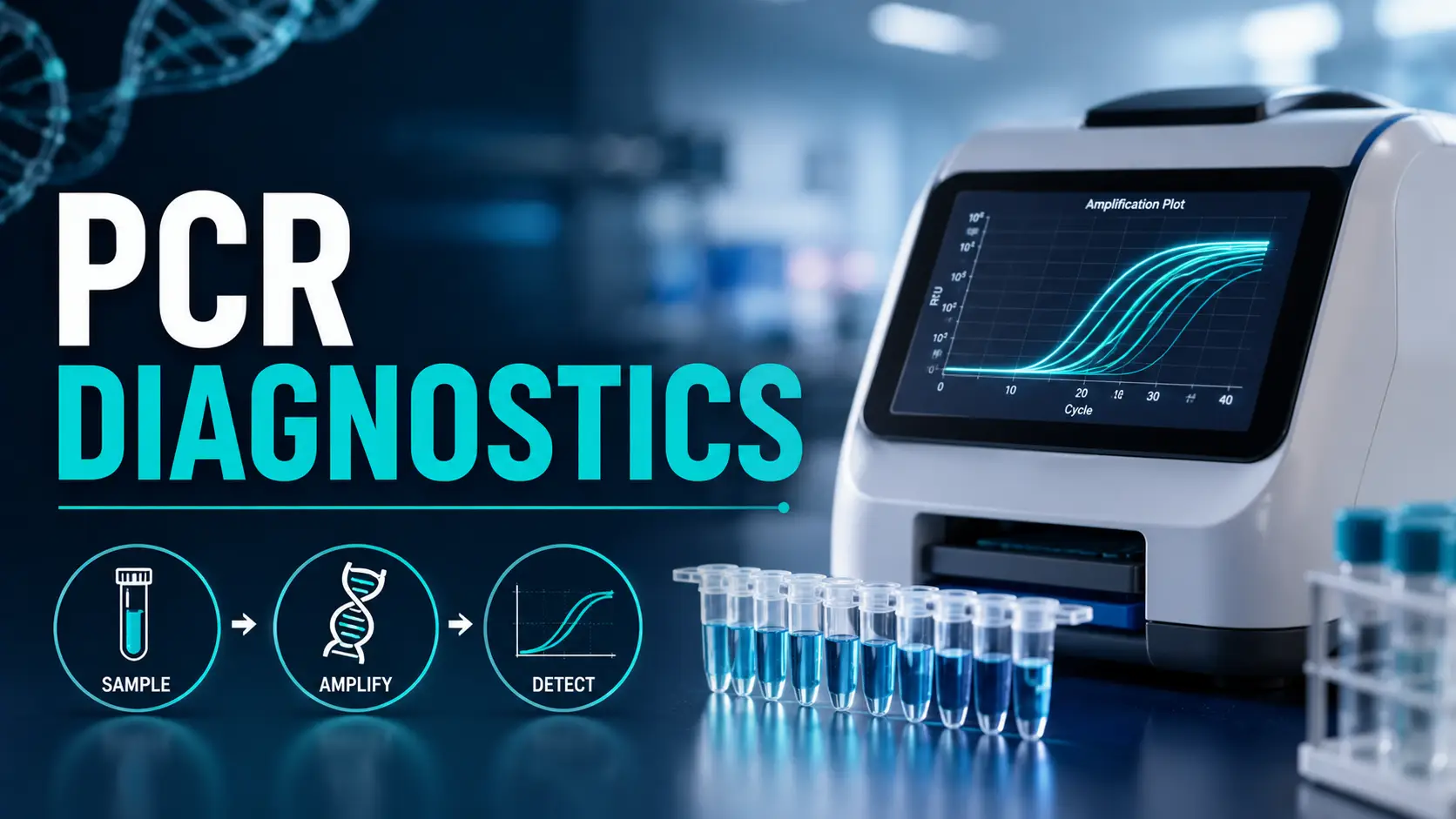
Most published material on PCR is written for the person receiving the result. This is written for the people who run it, buy it and sell it.
PCR diagnostics is the method underneath a very large share of modern infectious disease testing, and it has been in routine clinical use for decades. What changed after 2020 was not the chemistry but the expectation: PCR is now assumed to be fast, decentralised and available at volume, and every commercial conversation in this space runs into that assumption somewhere. This guide covers what PCR does in a clinical laboratory, the workflow and where it actually breaks, the differences between real time, endpoint and digital PCR, how PCR compares with antigen testing, and what a laboratory weighs before it buys a platform. For the wider context of the field, see our guide to what molecular diagnostics is.
The polymerase chain reaction amplifies a specific target sequence of DNA, doubling it with each thermal cycle until enough copies exist to be detected reliably. That exponential amplification is why PCR can find a pathogen present at very low concentration, and it is the single property that makes the method clinically valuable.
Where the target is RNA, as with influenza, SARS-CoV-2 and many other viruses, a reverse transcription step converts it to DNA first. This is why clinical assays for respiratory viruses are properly described as RT-PCR.
In practice a clinical laboratory uses PCR for four things: identifying a pathogen precisely, quantifying how much of it is present, detecting a resistance gene or a mutation, and confirming or excluding a result from a faster but less specific test. Those are four different clinical questions, and a platform that serves one well does not automatically serve the others.
Every PCR test moves through the same five stages. Understanding which stage constrains a given laboratory is the difference between a relevant sales conversation and an irrelevant one.
The amplification step is largely solved and broadly comparable between platforms. Competition now sits at either end: automating extraction and sample handling, and getting an authorised result into a clinical workflow without manual transcription. Vendors who pitch cycle time to a laboratory whose constraint is extraction capacity or middleware integration are answering a question nobody asked.
Three formats are in clinical and near clinical use, and they answer different questions.
| Format | How It Reads | Output | Typical Clinical Use |
|---|---|---|---|
| Real-time PCR (qPCR) | Fluorescence measured during each cycle | Detection plus relative quantification via cycle threshold | The workhorse of routine infectious disease testing |
| Endpoint PCR | Signal read once, after cycling completes | Present or absent | Largely superseded in routine diagnostics, retained in some specialist workflows |
| Digital PCR (dPCR) | Reaction partitioned into thousands of micro-reactions, each scored | Absolute quantification without a standard curve | Low abundance targets, residual disease monitoring, rare variant detection |
Real time PCR dominates routine work and is what most people mean by PCR diagnostics. Digital PCR is not a replacement for it. It is a precision instrument for situations where knowing the exact quantity matters and where the target is present at very low levels, and it carries a cost per test that routine screening cannot absorb.
This comparison became public knowledge during the pandemic and is still frequently misstated.
| PCR | Rapid Antigen | |
|---|---|---|
| What it detects | Genetic material from the pathogen | Pathogen proteins |
| Sensitivity | High, detects very low target levels | Lower, needs a higher pathogen load |
| Time to result | Roughly one to a few hours on platform | Around 15 to 30 minutes |
| Where it runs | Laboratory, or a cartridge system near the patient | Point of care, or self testing |
| Best used for | Confirming or excluding infection, resistance detection, quantification | Rapid triage when the pathogen load is likely high |
The two are complementary rather than competing. Antigen testing answers quickly when the answer is likely to be positive and the load is high. PCR is what you use when a negative result has to be trusted. A commercial argument that positions one as simply better than the other tends to be dismissed by laboratory staff, because the choice is driven by the clinical question rather than by test performance in isolation.
Manufacturers quote run time. Laboratories experience turnaround time, and the gap between them is where credibility is won or lost.
A run may take an hour, but a sample typically waits for transport from the ward or another site, waits to be batched with enough others to justify a run, queues behind urgent work, then waits for authorisation and transmission. In a batched laboratory workflow, the time on the instrument is often a small fraction of the total.
This is why random access platforms, which let a single urgent sample be run immediately without waiting for a batch, and cartridge based systems placed near the patient have changed clinical practice more than incremental improvements in cycling speed. It is also why how a pathology network is organised has a direct effect on what a faster assay is actually worth: in a hub and spoke model, transport to the hub can exceed the run time several times over.
How To Make The Speed Argument Credibly
Quote the change in total turnaround for a defined pathway, not the run time. A laboratory director can verify a claim about sample to result in their own service. A claim about cycling speed tells them nothing about whether a clinician gets an answer any sooner.
PCR diagnostics is a mature market, which means a laboratory considering a new platform is almost always replacing something that already works. The bar is correspondingly high.
The commercial reading is that the winning argument in PCR is rarely about the reaction. It is about menu fit, hands on time, integration and total cost per reportable result. Companies that lead with amplification performance are competing on the one dimension where the field has largely converged.
FutureDx Summit 2026 is a two day conference on infectious disease and molecular diagnostics, held on 27 and 28 October 2026 at the Copthorne Tara Hotel London Kensington. It brings together 150+ validated NHS and industry decision-makers and is officially supported by BIVDA, the not for profit trade association representing the in vitro diagnostics industry in the United Kingdom.
PCR runs through the programme rather than sitting in one session, which reflects how the method is actually used. The agenda covers sepsis diagnostics and drug resistant tuberculosis on Day 1, both of which are molecular detection problems, then AI in diagnostics and precision medicine on Day 2. Among the 23 confirmed speakers are Professor Adriana Calderaro, Director of Clinical Microbiology and Clinical Virology at the University Hospital of Parma, Elfatih Mustafa Awad-el-kariem, Consultant Microbiologist and Director for Infection Prevention and Control, and Peter Obami, Specialist Biomedical Scientist and Pathology IT lead at Barking, Havering and Redbridge University Hospitals. Clinical virology, infection control and pathology IT are three of the functions that decide whether a PCR platform is adoptable.
For companies selling molecular platforms, the molecular diagnostics sponsorship route sets out how packages map to commercial objectives, with dedicated routes for reaching NHS laboratory directors and for reagents and consumables suppliers. Packages include a defined number of pre-scheduled 1:1 meetings confirmed in advance.
What a focused summit provides is access and a credible setting to present verification and service level data to the people who evaluate it. It does not shorten a procurement cycle or guarantee an outcome.
PCR amplifies a specific target sequence of genetic material, doubling it with each thermal cycle until enough copies exist to detect. A clinical test moves through sample preparation, nucleic acid extraction, amplification across roughly 30 to 45 cycles, fluorescent detection, then interpretation and reporting. Where the target is RNA, a reverse transcription step converts it to DNA first, which is why viral assays are described as RT-PCR.
PCR detects the pathogen's genetic material and is highly sensitive, so it can find very low levels and a negative result can be trusted. Rapid antigen tests detect pathogen proteins, need a higher pathogen load, and return a result in around 15 to 30 minutes at the point of care. They are complementary: antigen testing is used for rapid triage where load is likely high, and PCR where infection must be confirmed or reliably excluded.
Real-time PCR, also called qPCR, measures fluorescence during each cycle rather than only at the end, giving both detection and relative quantification through the cycle threshold value. It is the standard format for routine clinical infectious disease testing, including respiratory and gastrointestinal pathogen detection, viral load monitoring and resistance gene detection.
The reaction itself typically runs in about one to a few hours, and cartridge systems can return results faster. Total turnaround is usually much longer, because samples wait for transport, batching, queueing behind urgent work, authorisation and transmission. In a hub and spoke pathology network, transport time can exceed the run time several times over, which is why random access and near patient platforms changed practice more than faster cycling did.
Digital PCR partitions a reaction into thousands of micro-reactions and scores each one, producing absolute quantification without needing a standard curve. It is used where exact quantity matters and targets are scarce, such as low abundance detection, residual disease monitoring and rare variant detection. Its cost per test means it complements rather than replaces real-time PCR in routine work.
PCR is mature, standardised and unusually well understood by its buyers, which raises rather than lowers the difficulty of selling into it. The chemistry is not the differentiator. What varies between platforms, and what a laboratory actually evaluates, is menu fit against local reporting, hands on time, extraction integration, verification support, how cleanly results reach the clinician, and cost per reportable result across the contract.
If you are taking a PCR diagnostics product to the UK market, the useful preparation is to be able to answer those six questions specifically for the laboratory in front of you. Getting into that conversation at all is the harder problem, and it is the one a focused conference is genuinely good at solving.
Academia and Hospital or Other End-User organisations attend FutureDx Summit 2026 free.
Complimentary passes are reserved for Academia and Hospital or Other End-User organisations. Solution Providers are not eligible for a complimentary pass. Register here.