AN
Anwesha Mishra
Convolign Business Consulting LLP
If you work on the commercial side of the diagnostics industry, you will hear the phrase molecular diagnostics constantly. It shapes product roadmaps, investment decisions, and the way conferences and buyers group themselves. This guide answers the question directly and practically: what is molecular diagnostics, how does it work, and why does it matter commercially. […]
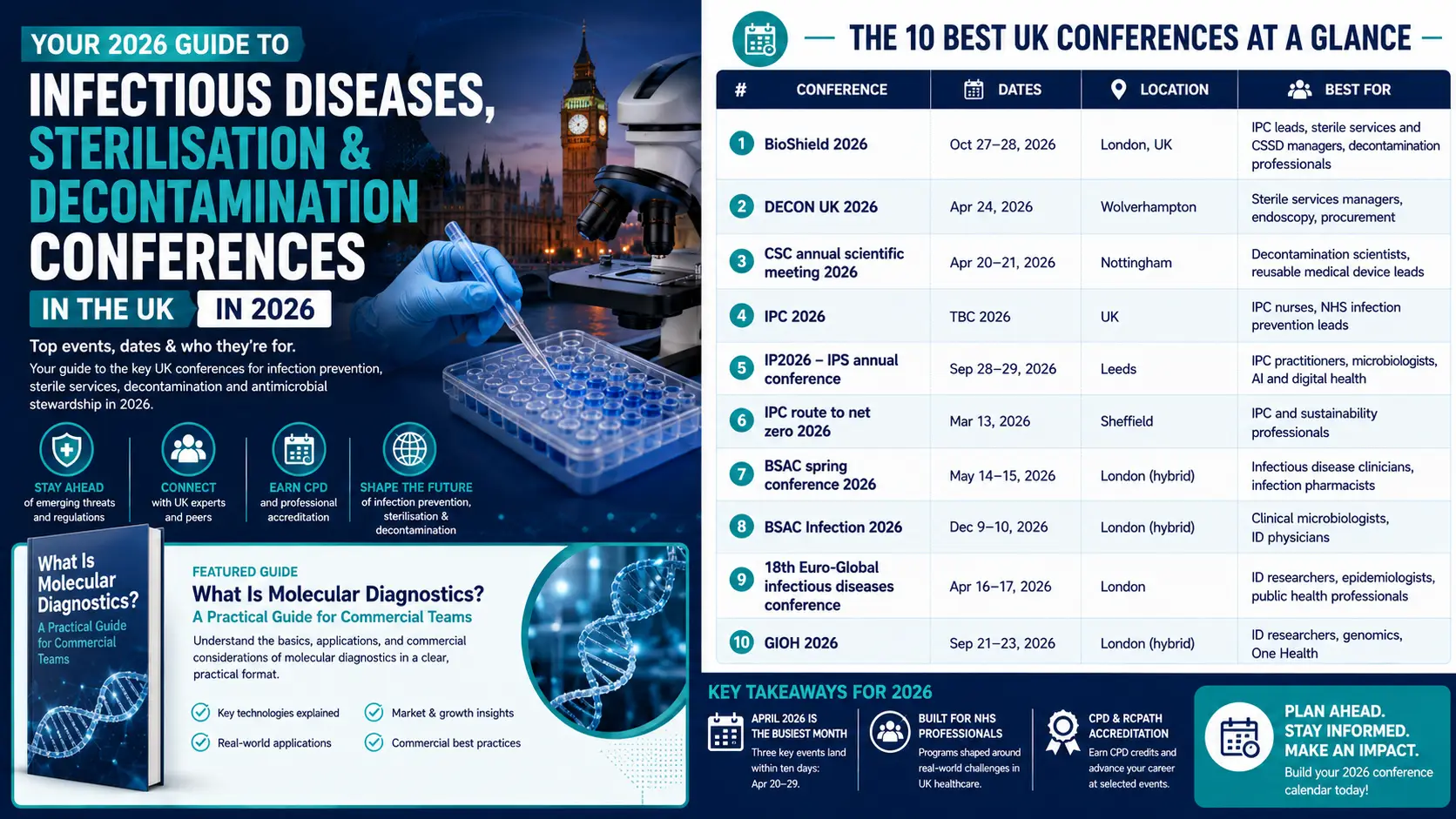
If you work on the commercial side of the diagnostics industry, you will hear the phrase molecular diagnostics constantly. It shapes product roadmaps, investment decisions, and the way conferences and buyers group themselves. This guide answers the question directly and practically: what is molecular diagnostics, how does it work, and why does it matter commercially.
The aim is not a textbook definition. It is a usable explanation for commercial, marketing and business development teams who need to understand the field well enough to sell into it or partner within it. For the market structure and who the companies are, our companion guide to molecular diagnostics companies maps the industry itself.
Molecular diagnostics is the branch of laboratory testing that detects specific sequences of genetic material, DNA and RNA, to diagnose disease. Rather than looking for a whole organism, a protein, or an antibody, a molecular test looks for the precise genetic signature of a pathogen, a cancer mutation, or an inherited condition.
That precision is the point. Because molecular testing reads the underlying genetic code, it can detect disease earlier, distinguish between closely related organisms, and identify resistance or mutation that older methods miss.
In One Sentence
Molecular diagnostics is testing that identifies disease by detecting its genetic fingerprint, giving faster and more specific answers than many traditional methods.
Most molecular diagnostic tests follow the same broad path from sample to answer, even when the underlying chemistry differs.
The most common amplification method is the polymerase chain reaction, usually shortened to PCR. Each of these five steps is a place where a company can compete, which is why the market contains extraction specialists, reagent suppliers, instrument makers and informatics companies that never sell a complete test between them.
When people ask what molecular diagnostics is, they are usually asking about a family of technologies rather than a single test. These are the ones commercial teams need to recognise.
| Technology | What It Does | Where It Fits |
|---|---|---|
| PCR and real-time PCR | Amplifies a genetic target so it can be detected and quantified. | The default method across most clinical molecular testing. |
| Multiplex and syndromic panels | Detect many pathogens from one sample in a single run. | Where the clinical question is broad, such as respiratory or gastrointestinal infection. |
| Next-generation sequencing | Reads DNA or RNA at scale rather than testing for named targets. | Genomics, oncology, and unbiased pathogen detection. |
| Point-of-care molecular | Delivers PCR level testing near the patient with a short time to result. | Emergency care, primary care and decentralised settings. |
| Isothermal amplification | Amplifies genetic material at a constant temperature, removing thermal cycling. | Simpler, lower cost rapid formats and field deployable tests. |
This is where commercial teams most often misread the market. The technologies are not competing to be best in the abstract. They answer different clinical questions, and the buyer chooses on the shape of the question rather than on specification.
Answering those five questions about a prospect tells you more about your chances than any feature comparison.
Molecular diagnostics spans three broad clinical areas, and each represents a distinct commercial opportunity with different buyers and different evidence expectations.
The largest and fastest moving application. Molecular tests identify the exact pathogen causing an infection, detect antimicrobial resistance genes, and support rapid decisions in sepsis, respiratory infection and tuberculosis. Where resistance is the question, molecular detection sits alongside rather than replaces phenotypic antibiotic susceptibility testing, because a resistance gene indicates likely resistance while a susceptibility result confirms what will actually work.
In cancer care, molecular diagnostics identifies the mutations driving a tumour and guides targeted therapy through companion diagnostics. This is where diagnostics and pharmaceutical companies increasingly partner, and where a test can be tied contractually to a specific therapy.
Molecular testing identifies inherited conditions and pharmacogenomic markers that predict how a patient will respond to a drug, supporting the wider move toward precision medicine. Volumes are lower than infectious disease, and the interpretation burden is far higher.
To understand why the field grows so quickly, compare molecular diagnostics with the traditional methods it complements and sometimes replaces.
| Traditional Testing | Molecular Diagnostics | |
|---|---|---|
| Target | Whole organism, protein or antibody | Specific DNA or RNA sequence |
| Speed | Often hours to days, culture dependent | Minutes to hours |
| Specificity | Good, but can miss closely related variants | Very high, distinguishes closely related targets |
| Resistance detection | Requires additional culture and susceptibility steps | Can detect known resistance genes directly |
| Main limitation | Time to result | Detects only what it is designed to look for |
That last row matters and is frequently left out of vendor material. A molecular test finds the targets it was designed to find, so a negative result is not proof of absence in the way a culture result can be. Buyers know this, and companies that acknowledge it in their positioning are taken more seriously than those that do not.
Understanding what molecular diagnostics is only matters commercially if you also understand who buys it. In the UK the decision-makers are a small and specific group: laboratory directors, consultant microbiologists and virologists, point-of-care coordinators, and clinical scientists, mostly within the NHS.
These buyers are difficult to reach at scale. Adoption runs through technical evaluation, local verification, accreditation requirements and business case approval, and the people who evaluate a test are often not the people who authorise the spend. For diagnostics companies the constraint is rarely the science. It is access to the right decision-makers, and increasingly the ability to reach several of them at once.
FutureDx Summit 2026 is a UK conference dedicated to infectious disease and molecular diagnostics, held on 27 and 28 October 2026 at the Copthorne Tara Hotel London Kensington. It brings together 150+ validated NHS and industry decision-makers and is officially supported by BIVDA, the not for profit trade association representing the in vitro diagnostics industry in the United Kingdom.
What makes it useful for understanding this field is that the confirmed speaker list spans the whole molecular spectrum described above rather than one corner of it. Among the 23 confirmed speakers are Jean Lutamyo Mbisa, Deputy Director for Public Health Microbiology Reference and Genomics at the UK Health Security Agency, Professor Adriana Calderaro, Director of Clinical Microbiology and Clinical Virology at the University Hospital of Parma, Suparna Mitra, Microbiome and AMR Research Lead at the University of Leeds, and Williams Tabowei, POCT Healthcare Scientist at James Paget University Hospitals NHS Foundation Trust. Genomics, clinical microbiology, resistance and point-of-care testing are each represented by the people who actually run those services.
The two day agenda maps onto the applications in this guide: sepsis diagnostics, drug resistant tuberculosis and community screening on Day 1, then AI in diagnostics and precision medicine on Day 2. For companies wanting commercial access rather than attendance, sponsorship packages include a defined number of pre-scheduled 1:1 meetings confirmed before the event, and there are dedicated routes for reaching NHS laboratory directors and consultant microbiologists.
To set expectations honestly: a focused conference gives structured access to senior buyers and a credible setting to present evidence. It does not accelerate NHS procurement or guarantee a commercial outcome. Its value is in starting the right conversations earlier than other channels manage.
Molecular diagnostics is laboratory testing that detects specific DNA or RNA sequences to diagnose disease. It identifies the genetic fingerprint of a pathogen, cancer mutation or inherited condition, giving faster and more specific results than many traditional methods.
Common examples include PCR tests for infections, multiplex syndromic panels that detect many pathogens at once, next-generation sequencing for genomics and oncology, rapid point-of-care molecular tests used near the patient, and isothermal amplification assays used in simpler rapid formats.
Traditional testing looks for a whole organism, protein or antibody, while molecular diagnostics detects a specific genetic sequence. Molecular methods are usually faster and more specific and can detect known resistance genes directly. The trade-off is that a molecular test finds only the targets it was designed to detect.
The main technologies are PCR and real-time PCR, multiplex and syndromic panels, next-generation sequencing, point-of-care molecular testing, and isothermal amplification. Most laboratories run several of these alongside each other rather than standardising on one.
Because it is one of the fastest growing areas in healthcare but its buyers are a small and specific group of NHS decision-makers. Commercial success depends on identifying which technology answers a given buyer's clinical question and then reaching the people who evaluate and authorise adoption.
Molecular diagnostics is a method, not a market segment. Once you can place a product against the five questions above, which clinical question it answers, how many answers at once, where the decision is made, what infrastructure exists, and who pays, the commercial strategy usually becomes obvious.
The harder part is reaching the small group of people who make those decisions in the UK, which is a different problem from understanding the science.
Academia and Hospital or Other End-User organisations attend FutureDx Summit 2026 free.
Complimentary passes are reserved for Academia and Hospital or Other End-User organisations. Solution Providers are not eligible for a complimentary pass. Register here.