SW
Swastik
Convolign Business Consulting LLP
Tuberculosis is curable, and has been for decades. It remains one of the world’s deadliest infectious diseases anyway, and the reason is rarely the drugs. It is that people are diagnosed late, or diagnosed without knowing which drugs will still work against the strain they are carrying. That makes TB a diagnostics problem before it […]
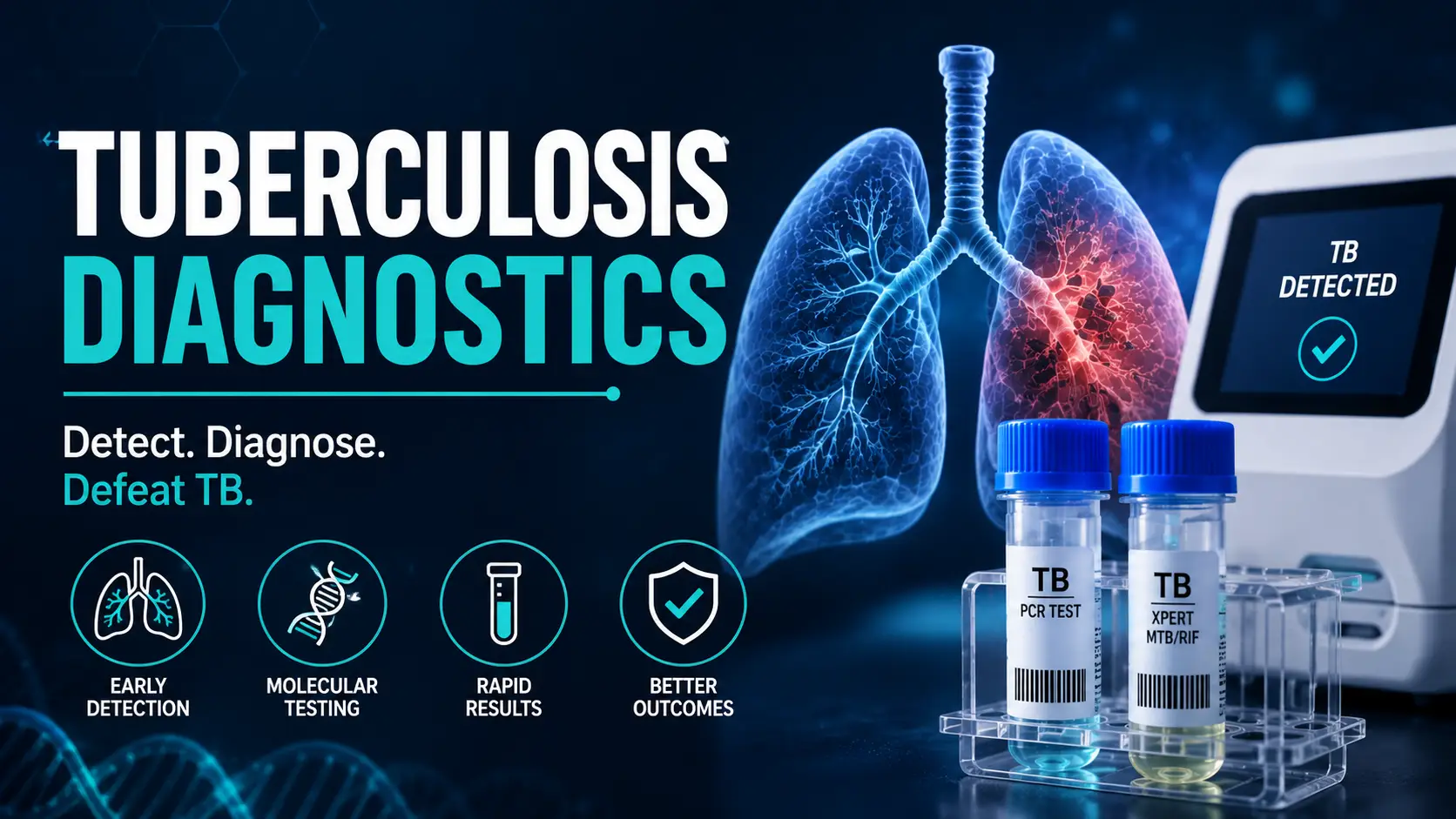
Tuberculosis is curable, and has been for decades. It remains one of the world’s deadliest infectious diseases anyway, and the reason is rarely the drugs. It is that people are diagnosed late, or diagnosed without knowing which drugs will still work against the strain they are carrying.
That makes TB a diagnostics problem before it is a treatment problem, which is why tuberculosis diagnostics attracts sustained investment and sustained scrutiny. This guide covers how TB is actually diagnosed, the rapid molecular tests that changed the field, how drug resistant TB is detected, and how the UK approaches it differently from most health systems. The last two sections matter most if you develop or sell TB diagnostics, because the UK reference model is unusual and it changes what a supplier is competing against.
Three features of the organism create the whole diagnostic challenge.
The pathway splits at that latent versus active distinction.
Two approaches are used, and neither confirms active disease. The tuberculin skin test involves injecting a small amount of fluid into the forearm and reading the induration 48 to 72 hours later. Interferon gamma release assays are blood tests that measure the immune response to TB specific proteins, and they have the practical advantage of not being confounded by prior BCG vaccination, which matters in populations where BCG is routine.
Where symptoms suggest active disease, the workup combines imaging and laboratory testing. A chest X-ray identifies cavitation and other suggestive changes but cannot confirm the organism. Sputum is then examined by smear microscopy, which is fast and cheap but insensitive, by culture, which is sensitive and remains the reference standard but slow, and by rapid molecular testing, which is where the field has moved. Where disease is suspected outside the lungs, tissue samples or other fluids are used instead, and diagnosis is harder still.
The significant shift was moving the first line test from microscopy to nucleic acid amplification, so that detection of the organism and detection of resistance happen in the same run, in hours rather than weeks.
The World Health Organization now recommends rapid molecular diagnostic tests as the initial test for people being evaluated for TB, rather than smear microscopy, and specifically for detecting M. tuberculosis together with resistance to rifampicin and to fluoroquinolones. Cartridge based automated systems, of which the Xpert MTB/RIF family is the most widely deployed, return a result on both questions in around two hours from an unprocessed sputum sample. In 2020 the WHO also recommended the TrueNat MTB and MTB Plus assays as an initial diagnostic test, extending the same principle to a lower infrastructure format.
These are molecular methods in the sense described in our guide to molecular diagnostics. Line probe assays occupy a different position. They detect a broader panel of resistance mutations, including isoniazid and second line agents, but require more laboratory capability and are generally used as a second step rather than as an initial test.
The Commercial Point
The competitive question in tuberculosis diagnostics is no longer whether a test can detect the organism. It is how much resistance information the test returns, how quickly, and how little infrastructure it needs to run. A product that answers only the first question is competing against methods that answer all three.
Resistance is what turns a treatable infection into a prolonged and sometimes untreatable one, and detecting it is the central diagnostic problem.
Multidrug resistant TB is defined by resistance to at least isoniazid and rifampicin, the two most important first line drugs. Rifampicin resistance is the practical trigger in most testing algorithms, both because it is strongly associated with multidrug resistance and because it is detectable from a small number of well characterised mutations. Extensively drug resistant TB involves further resistance to fluoroquinolones and other key agents.
Three methods are used, and they answer subtly different questions.
| Method | What It Detects | Speed | Limitation |
|---|---|---|---|
| Phenotypic drug susceptibility testing | Whether the organism actually grows in the presence of the drug | Weeks, dependent on culture | Slow, but remains the reference for many agents |
| Targeted molecular tests | Specific known resistance mutations | Around two hours | Detects only the mutations it targets |
| Whole genome sequencing | The full resistance profile predicted from the genome, plus strain relatedness | Days, from a cultured isolate | Depends on the quality of the mutation catalogue |
This is where the UK differs from most health systems, and where suppliers most often misjudge the market.
TB in the UK is a notifiable disease. Cases are reported through the National TB Surveillance System run by the UK Health Security Agency, and case numbers are relatively stable at a high level: UKHSA reported 5,937 notifications in 2025 against 5,938 in 2024, following a period of increase that included an 11 per cent rise in England in 2023.
The structural difference is in the laboratory. Mycobacterial testing is centralised into the UKHSA National Mycobacterium Reference Service, and that service is built on whole genome sequencing. WGS is used for identification of mycobacterial species, for prediction of drug susceptibility and resistance, and for establishing relatedness between isolates so that transmission and clusters can be detected. Because sequencing data links back to the surveillance system at individual case level, diagnosis and outbreak investigation are effectively the same workflow.
Three commercial consequences follow, and they are not obvious from outside.
TB has an unusual commercial shape. It is a global health priority with substantial donor and public funding attached, and simultaneously a low incidence disease in most high income health systems. A product strategy that ignores that split tends to fail in both markets.
| Market | What Is Valued | What Fails |
|---|---|---|
| High burden settings | Low cost per test, minimal infrastructure, robustness, decentralised use | Products assuming stable power, cold chain and skilled staff |
| UK and similar low incidence systems | Speed to a rifampicin answer, integration with reference and surveillance workflows | Products duplicating what a sequencing based reference service already delivers |
| Both | WHO recommendation or clear alignment to it, published performance data | Performance claims without independent evaluation |
The WHO recommendation status point is worth emphasising. In TB diagnostics more than in most fields, procurement and clinical adoption follow international guidance closely, and a product without that endorsement or a credible route to it carries a persistent disadvantage regardless of its performance.
Drug resistant TB is a scheduled session on Day 1 of FutureDx Summit 2026, held on 27 and 28 October 2026 at the Copthorne Tara Hotel London Kensington. The session sits alongside sepsis diagnostics and community screening for blood borne viruses, and the full agenda covers both days.
For TB and AMR diagnostics companies the relevant point is who is in the room. The summit brings together 150+ validated NHS and industry decision-makers and is officially supported by BIVDA, the not for profit trade association representing the in vitro diagnostics industry in the United Kingdom. Among the 23 confirmed speakers are Richard Vipond, Deputy Director for Diagnostics and Pathogen Characterisation at the UK Health Security Agency, and Jean Lutamyo Mbisa, Deputy Director for Public Health Microbiology Reference and Genomics at UKHSA. Those are precisely the functions that run reference mycobacterial testing and the sequencing programme described above. Also speaking are Peter Gayo Munthali, Antimicrobial Stewardship Lead at University Hospital of Coventry and Warwickshire, and Elfatih Mustafa Awad-el-kariem, Consultant Microbiologist and Director for Infection Prevention and Control.
Commercial routes are organised by objective: the AMR diagnostics sponsorship route aligns a company with the resistance sessions, and there are dedicated routes for reaching consultant microbiologists and infectious disease consultants. Packages include a defined number of pre-scheduled 1:1 meetings confirmed before the event, and a speaking slot at senior tiers, which for a TB product is often more valuable than exhibition space because the evidence discussion is the sale.
What this cannot do is influence WHO recommendation status or shorten an NHS evaluation. What it can do is put a company in front of the small number of UK specialists who determine whether a TB diagnostic is worth evaluating at all.
Diagnosis depends on whether latent infection or active disease is suspected. Latent infection is identified using a tuberculin skin test or an interferon gamma release assay blood test. Active disease is investigated with a chest X-ray plus laboratory testing of sputum or other samples by rapid molecular testing, smear microscopy and culture. Culture remains the reference standard but can take several weeks.
Rapid molecular tests are the fastest confirmatory option, with cartridge based automated systems returning a result in around two hours directly from a sputum sample, and detecting rifampicin resistance in the same run. Smear microscopy is also fast but far less sensitive and cannot identify resistance or reliably distinguish M. tuberculosis from other mycobacteria.
By three complementary routes. Targeted molecular tests detect specific known resistance mutations, most importantly rifampicin resistance, within hours. Line probe assays cover a broader panel including isoniazid and second line drugs. Phenotypic drug susceptibility testing grows the organism in the presence of the drug and remains the reference for many agents but takes weeks. In the UK, whole genome sequencing at the national reference service predicts the resistance profile from the genome.
The main categories are cartridge based nucleic acid amplification tests such as the Xpert MTB/RIF family, which the World Health Organization recommends as an initial diagnostic test, the TrueNat MTB and MTB Plus assays recommended by WHO in 2020, line probe assays for extended resistance panels, and whole genome sequencing used at reference laboratory level for identification, resistance prediction and transmission analysis.
UKHSA reported 5,937 tuberculosis notifications in 2025, effectively unchanged from 5,938 in 2024, following a period of increase that included an 11 per cent rise in England in 2023. TB is a notifiable disease in the UK and cases are recorded through the National TB Surveillance System.
Tuberculosis diagnostics has moved from a slow culture based discipline to one where the initial test is expected to identify the organism and flag rifampicin resistance within hours. The remaining problems are the hard ones: paucibacillary disease, extrapulmonary TB, children, and the gap between detecting a known mutation and knowing what a strain will actually respond to.
For a company in this field the strategic decision is which market you are genuinely built for. High burden settings buy robustness and cost per test. The UK buys speed at the front of the pathway and integration with a sequencing based reference service that already answers the resistance question thoroughly. Very few products are the right answer to both, and the ones that struggle are usually the ones that never chose.
Academia and Hospital or Other End-User organisations attend FutureDx Summit 2026 free.
Complimentary passes are reserved for Academia and Hospital or Other End-User organisations. Solution Providers are not eligible for a complimentary pass. Register here.