SW
Swastik
Convolign Business Consulting LLP
Molecular diagnostics companies sit at the centre of modern healthcare. They build the tests that detect infection, guide cancer treatment, and identify genetic disease at the level of DNA and RNA. As demand for faster, more precise testing grows, the number of molecular diagnostics companies competing for laboratory and clinical budgets has grown with it. […]
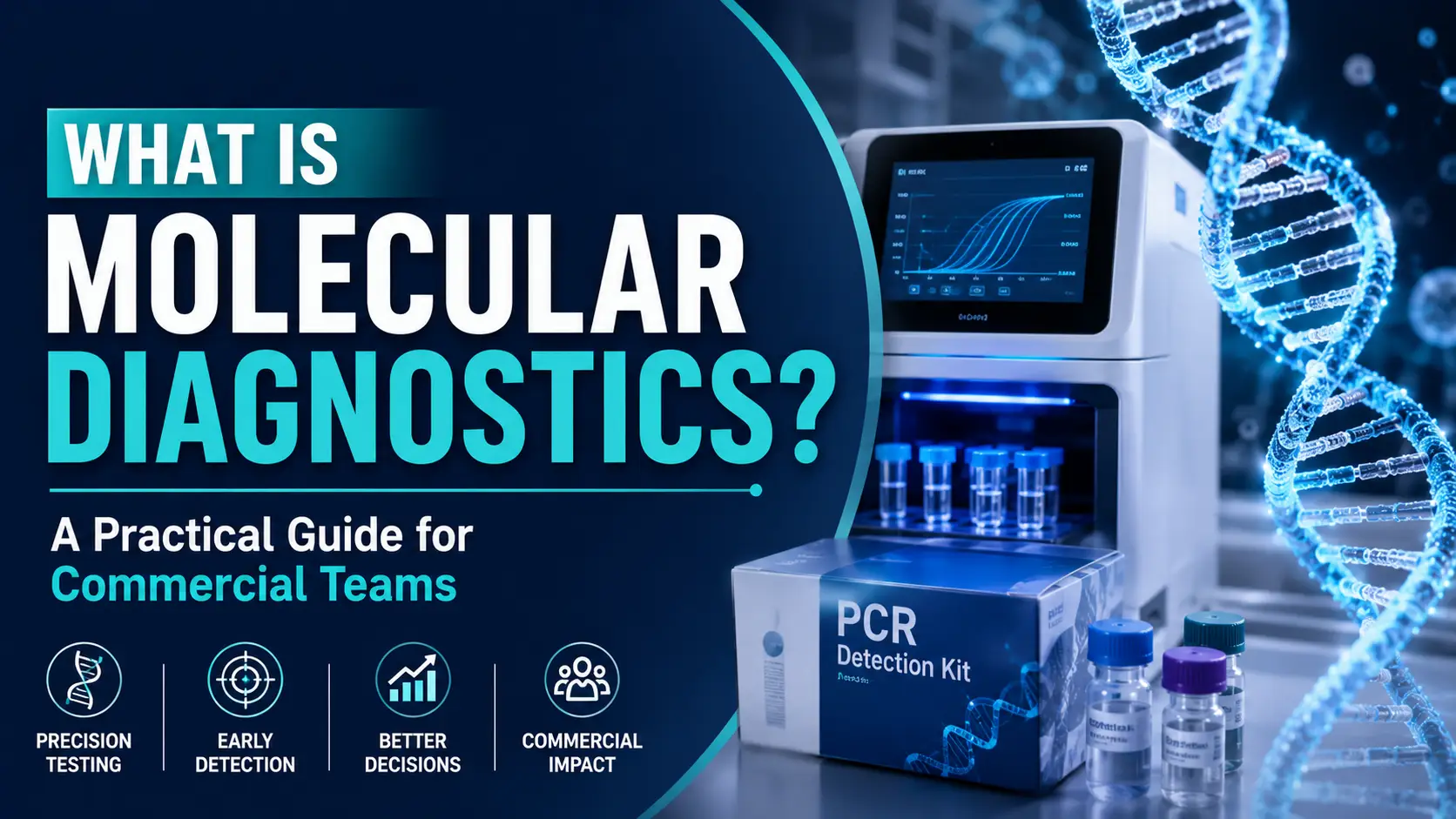
Molecular diagnostics companies sit at the centre of modern healthcare. They build the tests that detect infection, guide cancer treatment, and identify genetic disease at the level of DNA and RNA. As demand for faster, more precise testing grows, the number of molecular diagnostics companies competing for laboratory and clinical budgets has grown with it.
For anyone selling into this market, or planning where to invest commercial effort, understanding how the field is structured matters. This guide maps what molecular diagnostics companies do, how the market breaks down by tier and by technology, who the buyers actually are in the UK, and how these companies reach the people who decide which platforms get adopted. If you need the underlying science first, our guide to what molecular diagnostics is covers the methods and applications. This article is about the companies and the market.
Molecular diagnostics companies develop and sell the instruments, assays, reagents, and software used to detect specific genetic sequences in a patient sample. Instead of looking for a whole organism or an antibody, these tests look for the molecular signature of a disease.
The output of a molecular diagnostics company usually falls into one of four groups:
Most molecular diagnostics companies build a business around an instrument and consumable model. The instrument creates a placement, and recurring assay and reagent sales generate the long-term revenue. This is why access to the laboratories and clinical teams who choose platforms matters so much commercially. A single placement decision can determine years of consumable revenue, which is also why incumbents defend their installed base hard.
The molecular diagnostics market is not a single homogeneous group. It breaks into distinct tiers, and each tier meets buyers in a different way and faces a different commercial problem.
A small number of global in vitro diagnostics groups hold the largest share of installed instruments. They compete on menu breadth, automation, and the ability to serve high throughput central laboratories. For these companies the commercial challenge is defending share and launching new assays into an existing base, so their conference activity is often about maintaining relationships and visibility rather than discovery.
Below the global groups sit specialist molecular diagnostics companies focused on a single technology or disease area. They frequently lead on innovation, moving faster than the large groups on syndromic panels, rapid tests, or sequencing workflows. Their commercial challenge is visibility. They need decision-makers to know they exist, and they are competing for attention against companies with far larger field teams.
The newest layer consists of venture backed molecular diagnostics companies bringing novel chemistry, point-of-care formats, or AI driven interpretation to market. For these companies every meeting with a genuine buyer counts, because commercial runway is finite and adoption cycles are long. Their difficulty is credibility as much as access: a laboratory director evaluating an unfamiliar company is assessing whether it will still exist in three years.
Whatever the size of the company, the buyers are the same small group of laboratory directors, consultant microbiologists, point-of-care coordinators and procurement leads. Getting in front of them is the constraint, not the science.
It also helps to group molecular diagnostics companies by the technology they build on, because this determines who they sell to and which rooms they need to be in.
| Technology | What It Does | Typical Buyer |
|---|---|---|
| PCR and real-time PCR | Amplifies and detects specific genetic targets. The workhorse of molecular testing. | Molecular laboratory managers, microbiology |
| Syndromic multiplex panels | Detect many pathogens from one sample in a single run. | Microbiology, infection teams |
| Next-generation sequencing | Reads DNA or RNA at scale for genomics, oncology and pathogen detection. | Genomics leads, bioinformatics |
| Point-of-care molecular | Brings PCR level testing to the bedside or clinic. | POCT coordinators, emergency and primary care |
| Companion diagnostics | Guides targeted therapy by detecting a biomarker. | Pathology, oncology, pharma partners |
These categories are not rigid, and many companies span several. What matters commercially is that each maps to a different set of decision-makers who rarely sit in the same room outside a focused industry event. A company selling a POCT molecular platform and a company selling a sequencing workflow are nominally in the same market and are in practice selling to entirely different people.
The UK is one of the most closely watched markets in the world for molecular diagnostics companies. The NHS is a single, large, highly networked buyer, which makes it attractive and difficult in equal measure.
Selling molecular diagnostics into the NHS means working with several realities:
This is the core commercial problem. The science is frequently ready before the pipeline is, and reaching the right NHS buyers efficiently is what separates companies that grow from companies that stall.
Historically these companies have relied on three commercial channels, and each has a clear limit.
Field sales is effective but expensive and slow when the target is a small number of senior NHS decision-makers whose diaries are difficult to access. Large trade shows deliver footfall and impressions, but a large proportion of that footfall is not a qualified buyer for a molecular platform. Digital outbound reaches inboxes, though rarely the right inbox, and rarely with enough established trust to open a procurement conversation.
A focused summit addresses a different problem. Rather than maximising reach, it concentrates on the quality of the conversation. When the audience is curated and meetings are arranged in advance, the value is in knowing who you will be sitting with before you travel. Measured on cost per qualified conversation rather than on impressions or footfall, a focused event and a large exhibition stand are very different propositions.
FutureDx Summit 2026 was created to address the access problem directly. It is a UK conference dedicated to infectious disease and molecular diagnostics, held on 27 and 28 October 2026 at the Copthorne Tara Hotel London Kensington, and it is built around bringing the companies that make the tests together with the NHS and clinical decision-makers who adopt them, with meetings structured in advance.
The summit convenes 150+ validated NHS and industry decision-makers across two days. The relevant credibility marker for companies in this sector is that FutureDx is officially supported by BIVDA, the not for profit trade association representing the in vitro diagnostics industry in the United Kingdom. Both Angela Douglas MBE, President of BIVDA, and Helen Dent, Chief Executive of BIVDA, are confirmed speakers.
The 23 confirmed speakers indicate the type of delegate the programme attracts. They include Richard Vipond, Deputy Director for Diagnostics and Pathogen Characterisation at the UK Health Security Agency, Peter Obami, Specialist Biomedical Scientist and Pathology IT lead at Barking, Havering and Redbridge University Hospitals, Shazeena Hussain, POCT Specialist Biomedical Scientist at Bedfordshire Hospitals NHS Foundation Trust, and Georgina Wilson, Senior Biomedical Scientist at Severn Pathology. These are the evaluator and gatekeeper roles described earlier in this article.
The two day agenda covers sepsis diagnostics, drug resistant tuberculosis and community screening on Day 1, then AI in diagnostics and precision medicine on Day 2. Sponsorship tiers are built around a defined number of pre-scheduled 1:1 meetings, 15 at Headline, 10 at Platinum and 6 at Gold, alongside a speaking slot in the main programme at the senior tiers and the delegate list for follow up.
It is worth being precise about what this does and does not offer. A focused summit gives structured access to decision-makers who are otherwise hard to reach, a credible platform to present clinical data to peers, and early visibility for companies the market does not yet know. It does not shorten NHS procurement, and it does not guarantee a contract. Companies that treat it as the opening of a relationship rather than the closing of a sale get considerably more from it.
The molecular diagnostics market rewards companies that solve access, not only companies with the best chemistry. The science gets you a product. Reaching the right decision-makers gets you a business.
If you are weighing where to invest for the year, the guidance for diagnostics companies sets out how to think about return, and there are separate routes for business development leaders and for UK based diagnostics companies.
Molecular diagnostics companies develop and sell the instruments, assays, reagents and software used to detect genetic material such as DNA and RNA in patient samples. Their products identify infections, cancer mutations and genetic disease at the molecular level, and most operate an instrument and consumable model where the platform placement drives recurring assay revenue.
In the UK the main buyers are NHS laboratory directors, consultant microbiologists and virologists, point-of-care testing coordinators, clinical scientists and pathology network procurement leads. The person who evaluates a platform technically is often not the person who authorises the spend, so most sales require several stakeholders to agree.
Four product groups: instruments and analysers that run the test, assays and reagents that detect the target, software and informatics that interpret and transmit results, and services such as companion diagnostic development partnerships with pharmaceutical companies. Many companies sell across several of these groups.
Adoption typically moves through technical evaluation, local verification against existing methods, accreditation and quality requirements, then business case approval, often at pathology network rather than single site level. Because the process involves multiple stakeholders over an extended period, companies usually combine field sales with focused conferences and clinical evidence publication rather than relying on one channel.
Because the buyers are a small, senior and hard to reach group. Focused conferences concentrate those decision-makers in one place and, where a pre-arranged meetings programme exists, convert attendance into confirmed conversations. The measure that matters is cost per qualified meeting rather than reach or footfall.
If you run commercial strategy at a molecular diagnostics company, the market map above is only useful if it changes where you spend. The tier you occupy sets your problem: incumbents defend, specialists need visibility, and emerging companies need credibility alongside access. All three ultimately compete for the attention of the same few hundred people in the UK.
The practical question is therefore not which channel produces the most activity, but which produces the most conversations with people who can actually say yes.
Academia and Hospital or Other End-User organisations attend FutureDx Summit 2026 free.
Complimentary passes are reserved for Academia and Hospital or Other End-User organisations. Solution Providers are not eligible for a complimentary pass. Register here.