SW
Swastik
Convolign Business Consulting LLP
Most of what is written about multiplex PCR testing explains primer design and reaction chemistry. That is not the decision anyone in a hospital is actually making. The decision is whether to buy a syndromic panel, for which patients, and whether the result justifies a cost that is often several times a targeted test. This […]
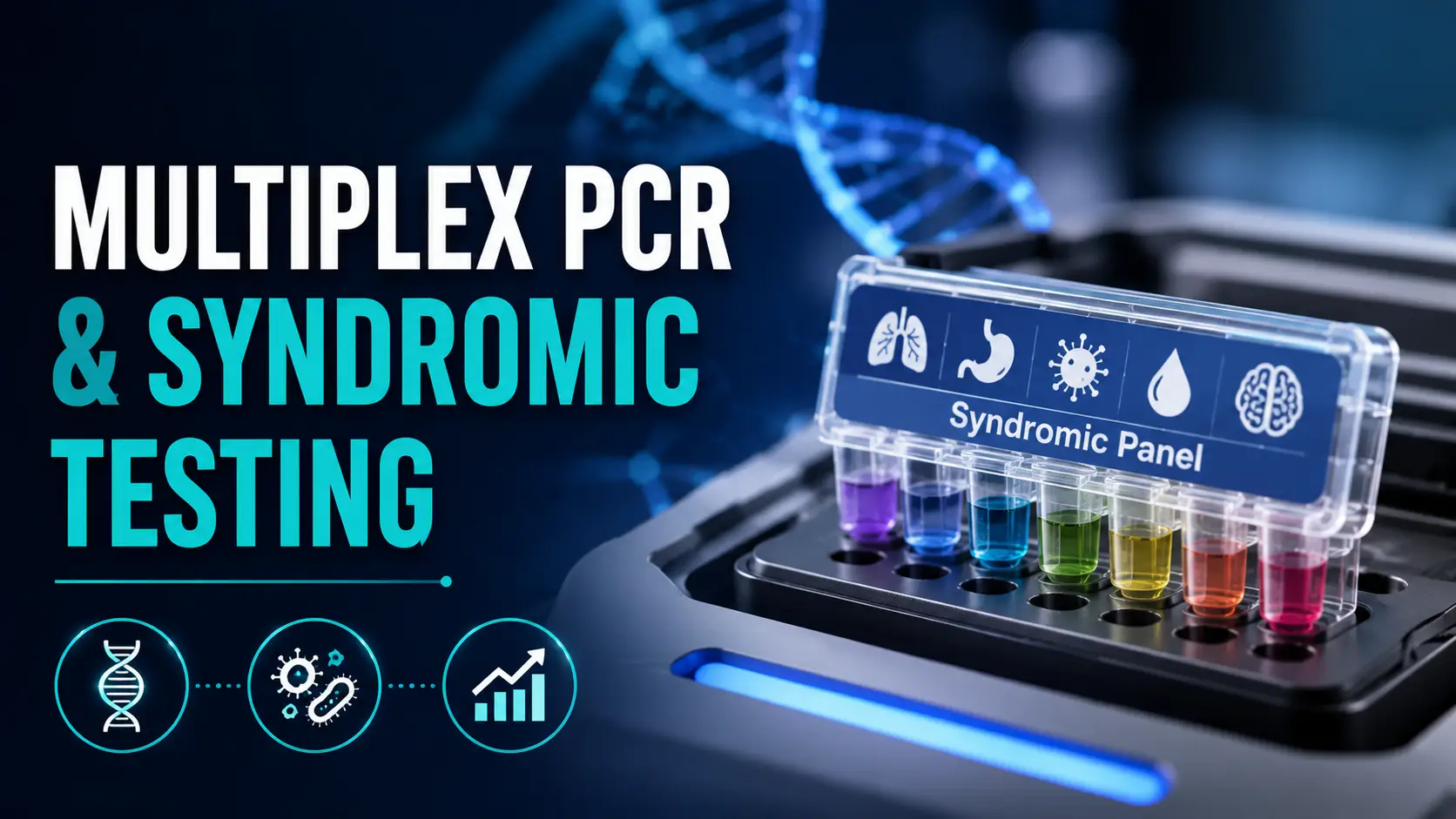
Most of what is written about multiplex PCR testing explains primer design and reaction chemistry. That is not the decision anyone in a hospital is actually making. The decision is whether to buy a syndromic panel, for which patients, and whether the result justifies a cost that is often several times a targeted test.
This is a buyer’s guide to that decision. It covers what multiplex PCR and syndromic testing mean in practice, which panels are in clinical use, the honest case for and against them, a framework for when a panel is justified over targeted testing, and the criteria a laboratory applies when evaluating one. If you need the underlying method first, our guide to PCR diagnostics covers how the reaction works.
The two terms are used interchangeably and should not be. One is a technique, the other is a product concept, and confusing them causes real problems in procurement conversations.
Multiplex PCR is the amplification of several targets in a single reaction, using a different primer pair for each. It is a laboratory technique, and it has been in use for decades. A two target assay is multiplex.
Syndromic testing is the clinical application of that technique: a panel designed around a presenting syndrome rather than a suspected organism. The clinician does not order a test for Campylobacter. They order a gastrointestinal panel because the patient has diarrhoea, and the panel reports on everything that could plausibly cause it.
That distinction is the whole commercial argument. Multiplex PCR is a capability. Syndromic testing is a change in how clinicians order and how laboratories are structured, and it is the second one that buyers are actually evaluating.
Panels cluster around syndromes where the differential is broad, the causative organisms are hard to distinguish clinically, and the answer changes management.
| Panel | Presenting Syndrome | Typical Setting | Why It Is Used |
|---|---|---|---|
| Respiratory | Acute respiratory infection | Emergency, acute admissions, winter surge | Influenza, COVID-19, RSV and others are clinically indistinguishable |
| Gastrointestinal | Acute diarrhoea | Emergency, community, outbreak investigation | Replaces a slow, multi method workup of culture, microscopy and antigen tests |
| Meningitis and encephalitis | Suspected CNS infection | Emergency, paediatrics, intensive care | Time critical, and the sample is precious and hard to repeat |
| Bloodstream infection | Suspected sepsis, positive blood culture | Intensive care, acute medicine | Organism identification and resistance markers hours earlier than culture |
| Sexually transmitted infection | Suspected STI | Sexual health services | Co-infection is common and single tests miss it |
| Joint or wound infection | Suspected deep infection | Orthopaedics, surgery | Culture is frequently negative after antibiotics have started |
Respiratory is the largest panel category by volume in most systems and has its own distinct evaluation questions around seasonality, point of care placement and surge capacity. It deserves separate treatment rather than being folded into a general panel discussion.
The argument in favour is genuinely strong in the right setting.
This is the section most vendor material omits, and its absence is precisely why laboratory directors discount vendor material. The objections are legitimate and a supplier who cannot discuss them credibly will not get far.
How Experienced Buyers Frame It
The question is not whether a panel is more sensitive. It usually is. The question is whether the additional organisms detected change what happens to the patient, often enough to justify the cost, without generating positives that lead to unnecessary treatment. A supplier who opens with that framing is treated very differently from one who opens with target count.
Five questions decide it. They are the same questions a laboratory will ask internally, so a commercial team that can answer them about a specific service is already ahead.
If you are selling a panel into UK microbiology, this is the checklist you are being scored against, whether or not anyone shows it to you.
Selective reporting deserves emphasis. Because panels detect more than clinicians need to act on, the ability to control what is released is what makes a panel safe to deploy at scale. Suppliers who treat reporting configuration as an afterthought lose deals they should have won on performance.
Syndromic testing decisions sit with the infection specialists and laboratory leads who attend FutureDx Summit 2026, held on 27 and 28 October 2026 at the Copthorne Tara Hotel London Kensington. The summit brings together 150+ validated NHS and industry decision-makers and is officially supported by BIVDA, the not for profit trade association representing the in vitro diagnostics industry in the United Kingdom.
The programme maps onto panel territory directly. Day 1 covers sepsis diagnostics, where bloodstream infection panels compete, and community screening for blood borne viruses. Among the 23 confirmed speakers are Professor Adriana Calderaro, Director of Clinical Microbiology and Clinical Virology at the University Hospital of Parma, Elfatih Mustafa Awad-el-kariem, Consultant Microbiologist and Director for Infection Prevention and Control, and Peter Gayo Munthali, Antimicrobial Stewardship Lead at University Hospital of Coventry and Warwickshire. Clinical microbiology, infection control and stewardship are exactly the three functions that jointly decide whether a panel gets adopted, and stewardship is the one suppliers most often fail to bring on side.
Commercial routes include the molecular diagnostics sponsorship route and dedicated routes for reaching consultant microbiologists and NHS laboratory directors, with packages built around a defined number of pre-scheduled 1:1 meetings. The agenda sets out both days.
To be plain about the limits: a conference does not shorten an NHS evaluation or guarantee adoption. It gives you the conversation with microbiology and stewardship in the same place, which for a syndromic panel is unusually valuable because those two functions have to agree.
Multiplex PCR testing amplifies several genetic targets in a single reaction, using a separate primer pair for each target. It allows one run to detect multiple organisms or markers from one sample, rather than running a separate test for each. It is a laboratory technique, distinct from the syndromic panel products built on top of it.
A syndromic panel is a test designed around a presenting clinical syndrome rather than a single suspected organism. Instead of ordering a test for one pathogen, a clinician orders a panel covering the organisms that could plausibly cause that presentation, such as a gastrointestinal panel for acute diarrhoea or a meningitis and encephalitis panel for suspected central nervous system infection.
It is most justified where the clinical differential is genuinely broad, the timing of the result changes management, and the sample is difficult to obtain or repeat. Suspected meningitis, positive blood cultures and acute respiratory presentations are common examples. Where a clinician already strongly suspects one organism, targeted testing is usually cheaper and equally useful.
The advantages are speed, a single sample and run replacing a multi step workup, and detection of organisms that were not specifically suspected. The disadvantages are a cost per test several times higher than targeted assays, detection of organisms that are present but not causing illness, the resulting risk of unnecessary treatment, and limited resistance information compared with full susceptibility testing. Controlling who can order the panel is central to managing the cost.
No. Panels detect a fixed set of targets and report limited resistance markers, whereas culture grows the organism and enables full antibiotic susceptibility testing. In practice panels are used to get an early actionable answer while culture continues in parallel to provide the definitive susceptibility profile.
Syndromic testing is not a better version of targeted testing. It is a different operating model, with a different cost base, a different ordering pattern and a different set of risks, and it is adopted where the clinical differential is wide and time matters.
For a supplier the practical implication is that the winning argument is rarely target count. It is cost per reportable result, control over what gets reported, and evidence that the extra detection changes management without driving unnecessary treatment. Bring stewardship into the conversation early, because they will be in it eventually.
Academia and Hospital or Other End-User organisations attend FutureDx Summit 2026 free.
Complimentary passes are reserved for Academia and Hospital or Other End-User organisations. Solution Providers are not eligible for a complimentary pass. Register here.