SW
Swastik
Convolign Business Consulting LLP
If you manufacture in vitro diagnostics, the IVDR has probably already reshaped your product roadmap, your evidence budget and your launch timelines. If you are entering the European or UK market for the first time, it determines what you can sell and when. This guide sets out what the IVDR is, what changed from the […]
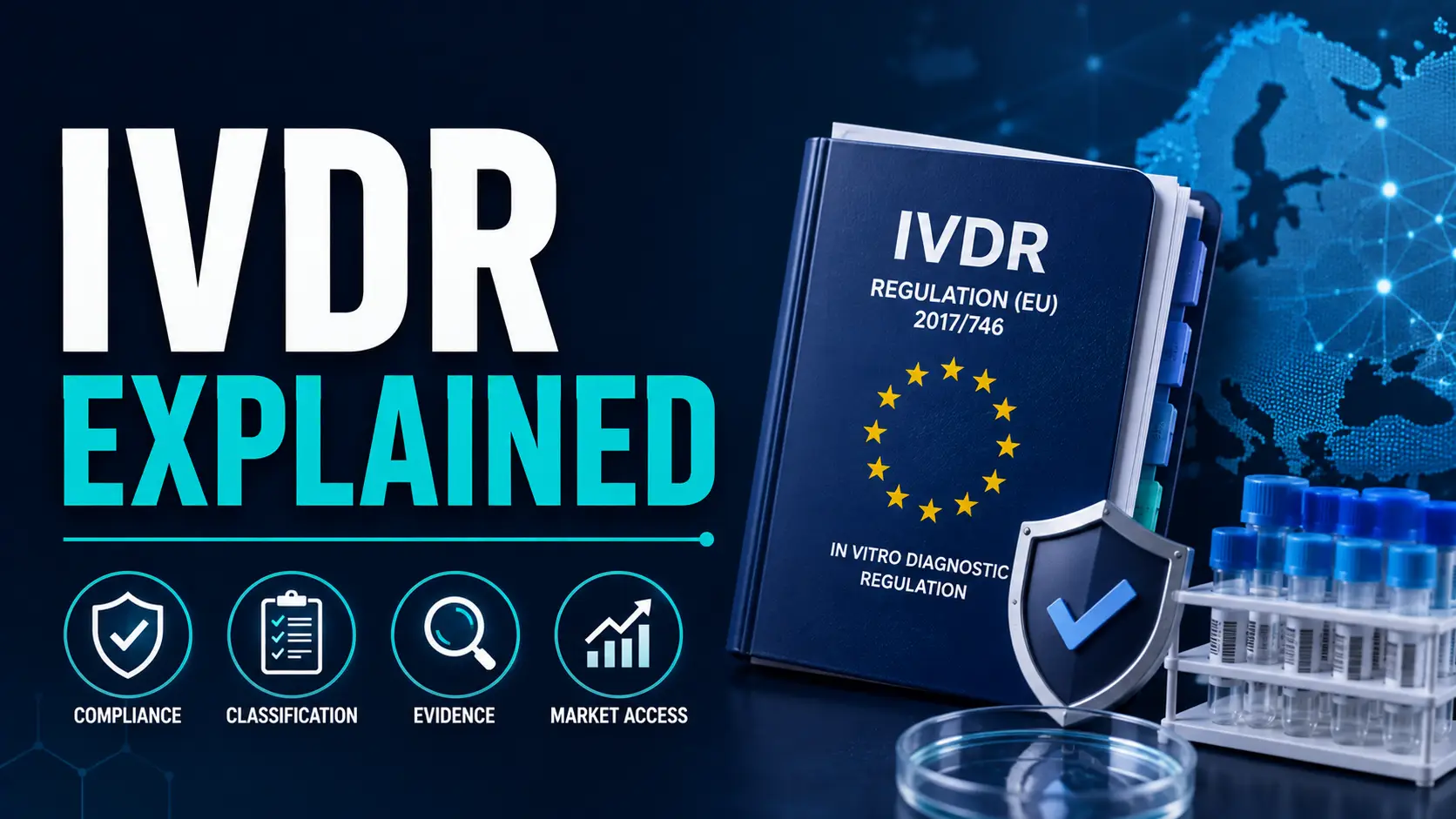
If you manufacture in vitro diagnostics, the IVDR has probably already reshaped your product roadmap, your evidence budget and your launch timelines. If you are entering the European or UK market for the first time, it determines what you can sell and when.
This guide sets out what the IVDR is, what changed from the directive it replaced, how the classification system drives your compliance workload, and what it requires of manufacturers. It also answers the question most UK focused searches are really asking and which most published guides skip: whether the IVDR applies in the United Kingdom, and what the UK regime is doing instead.
The IVDR is Regulation (EU) 2017/746, the European Union law governing in vitro diagnostic medical devices. It covers products used to examine specimens taken from the body, including reagents, calibrators, control materials, instruments, software and specimen receptacles.
It entered into force on 25 May 2017 and became applicable on 26 May 2022, repealing Directive 98/79/EC, the In Vitro Diagnostic Directive commonly called the IVDD. Transitional provisions have since been extended, most recently by Regulation (EU) 2024/1860, allowing certain legacy devices to remain on the market beyond the original dates provided specific conditions are met.
The intent behind the change was straightforward. The IVDD was a 1998 directive written before molecular diagnostics, companion diagnostics and diagnostic software existed in their current form, and it left the great majority of IVDs to be self certified by their manufacturer.
| Area | Under The IVDD | Under The IVDR |
|---|---|---|
| Classification | List based, with most devices unclassified and self certified | Rule based risk classification into Classes A, B, C and D |
| Independent assessment | Required for a small minority of devices | Required for the large majority |
| Evidence | Limited performance requirements | Formal performance evaluation covering scientific validity, analytical and clinical performance |
| Traceability | No unified identification system | Unique Device Identification and registration in EUDAMED |
| After launch | Basic vigilance reporting | Post-market surveillance and post-market performance follow-up as an ongoing obligation |
| Responsibility | Loosely defined | A named person responsible for regulatory compliance |
The single most consequential line in that table is the second. Industry and notified body estimates commonly put notified body involvement at roughly 20 per cent of IVDs under the directive, rising to around 80 per cent under the regulation. For many manufacturers this was the first time an external body had ever assessed their product, and notified body capacity became the binding constraint on the whole transition.
The IVDR replaced list based classification with seven rules that assign every device to one of four classes, based on the risk to the individual patient and to public health if the result is wrong.
Class determines everything downstream: whether you need a notified body, the depth of your technical documentation, the level of performance evidence, and for Class D the involvement of EU reference laboratories and batch verification. Two products that look similar on a bench can sit in different classes and carry entirely different cost and timeline profiles. Classification is therefore a commercial decision as much as a regulatory one, and getting it wrong early is expensive to correct late.
The practical obligations for a manufacturer placing a device on the EU market are as follows.
Two of these routinely surprise companies transitioning from the directive. Performance evaluation is a continuing obligation rather than a one off submission, and post-market performance follow-up means committing to collect real world data indefinitely. Both are ongoing costs that belong in the product business case, not in a one time compliance project.
No. The EU IVDR does not apply in Great Britain, and this is the point most guidance written for a European audience leaves unclear.
Great Britain, meaning England, Scotland and Wales, continues to regulate in vitro diagnostics under the UK Medical Devices Regulations 2002, overseen by the MHRA, with conformity indicated by the UKCA mark. Northern Ireland continues to follow the EU regulation under the Windsor Framework, which means a manufacturer selling across the whole United Kingdom is working to two regimes at once.
In practice the UK has continued to accept CE marked devices while its own regime is rebuilt. Current transitional arrangements recognise devices certified under the EU MDR, IVDR and IVDD in Great Britain until 30 June 2030, with an earlier date of 30 June 2028 for devices certified under the older MDD and AIMDD.
The UK position is actively moving, so anyone planning a market entry should check the current status rather than rely on a guide written a year ago.
The MHRA ran a targeted consultation that closed on 10 April 2026 proposing to extend the MDD and AIMDD deadline from 30 June 2028 to 31 December 2028, and to provide indefinite recognition in Great Britain for CE marked devices that comply with the EU MDR or IVDR. Outcomes were expected later in 2026. Separately, the draft Medical Devices (Amendment) Regulations 2026 set out a broader overhaul including an International Reliance route allowing manufacturers to rely on approvals from trusted regulators such as the FDA, Health Canada, the EU and Australia, stricter IVD classification aligned more closely to international practice, oversight of AI and software including predetermined change control plans, and strengthened post-market surveillance.
The Commercial Read
If indefinite recognition of CE marked IVDs is confirmed, IVDR compliance effectively becomes a route into Great Britain as well as the EU, and the UK becomes materially cheaper to enter for a company that has already done the EU work. If it is not confirmed, a separate UK conformity route remains. Either way, the companies that plan for both scenarios now will move faster than those waiting for certainty.
The IVDR is usually discussed as a compliance burden. For commercial teams it is more useful to read it as a change in market structure, because it has moved the competitive position of different kinds of company. The tiers below map onto the wider structure of the diagnostics market.
| Company Type | Effect Of The IVDR | Commercial Response |
|---|---|---|
| Large established IVD groups | Absorbable cost, existing regulatory function | Rationalise the portfolio, retire marginal legacy assays |
| Mid sized and specialist | Significant proportional cost across a broad menu | Prioritise assays with the strongest clinical and commercial case |
| Emerging and venture backed | Higher barrier to first launch, longer runway needed | Classify early, budget the evidence, plan notified body capacity well ahead |
| Laboratories running in house tests | Conditions attached to health institution exemption | Commercial opportunity where a laboratory decides to buy rather than maintain |
That last row is worth attention. Where a laboratory concludes that keeping an in house test compliant is no longer worth the effort, that test becomes an addressable opportunity for a commercial supplier. Identifying those situations requires conversations with laboratory directors and clinical leads, not market reports. Our guide to how NHS laboratory medicine is organised sets out who those people now are.
FutureDx Summit 2026 takes place on 27 and 28 October 2026 at the Copthorne Tara Hotel London Kensington, bringing together 150+ validated NHS and industry decision-makers over two days.
For a regulatory or market access audience the most relevant credential is the industry backing. The summit is officially supported by BIVDA, the not for profit trade association representing the in vitro diagnostics industry in the United Kingdom, and both Angela Douglas MBE, President of BIVDA, and Helen Dent, Chief Executive of BIVDA, are among the 23 confirmed speakers. BIVDA is the body that represents UK IVD manufacturers in exactly the regulatory conversations described above. Also speaking are Richard Vipond and Jean Lutamyo Mbisa, Deputy Directors at the UK Health Security Agency, alongside NHS laboratory and infection leads.
For companies weighing a UK market entry while the regime is in flux, that combination is the practical value: access to the trade association shaping the UK position and to the laboratory decision-makers who will buy the product once it is cleared. The two day agenda covers sepsis, drug resistant tuberculosis, AI in diagnostics and precision medicine, and sponsorship includes a defined number of pre-scheduled 1:1 meetings. There are dedicated routes for UK diagnostics companies, for US companies entering the UK and European market, and for diagnostics companies more broadly.
To be clear about the limits: a conference does not influence your regulatory outcome and does not accelerate a notified body queue. What it offers is early commercial groundwork with the buyers and industry bodies that matter once your device is cleared to sell.
IVDR is Regulation (EU) 2017/746, the European Union regulation governing in vitro diagnostic medical devices. It covers reagents, calibrators, controls, instruments, software and specimen receptacles used to examine samples taken from the body. It entered into force on 25 May 2017 and became applicable on 26 May 2022, replacing Directive 98/79/EC.
A quality management system, correct risk classification against the seven rules, technical documentation, a performance evaluation covering scientific validity and analytical and clinical performance, notified body conformity assessment for all but most Class A devices, Unique Device Identification and EUDAMED registration, a named person responsible for regulatory compliance, and ongoing post-market surveillance with post-market performance follow-up.
The IVDR entered into force on 25 May 2017 and became applicable on 26 May 2022. Transitional provisions have been extended since, most recently by Regulation (EU) 2024/1860, permitting certain legacy devices to remain on the market beyond the original dates where specific conditions are met.
The IVDD used list based classification and allowed most manufacturers to self certify. The IVDR applies rule based classification into Classes A to D, requires notified body assessment for the large majority of devices, mandates formal performance evaluation, introduces Unique Device Identification and EUDAMED registration, and makes post-market surveillance and performance follow-up continuing obligations. Estimates commonly place notified body involvement at around 20 per cent of devices under the directive against roughly 80 per cent under the regulation.
Not in Great Britain. England, Scotland and Wales regulate in vitro diagnostics under the UK Medical Devices Regulations 2002 with the UKCA mark, overseen by the MHRA. Northern Ireland follows the EU regulation under the Windsor Framework. Great Britain currently recognises devices certified under the EU MDR, IVDR and IVDD until 30 June 2030, and the MHRA has consulted on providing indefinite recognition for CE marked devices compliant with the EU MDR or IVDR.
For an IVD manufacturer the IVDR question is not really about compliance documents. It is a portfolio decision: which assays justify the classification, evidence and lifetime surveillance cost, and which do not. That calculation determines what you take to market in Europe, and increasingly what you take to the UK.
The UK adds a second decision, because the regime is genuinely unsettled. Companies that map both scenarios now, and build relationships with UK laboratory buyers and the industry bodies representing them while they wait, will be in position when the position clarifies. Those that treat the UK as a problem for later will be starting from cold.
Academia and Hospital or Other End-User organisations attend FutureDx Summit 2026 free.
Complimentary passes are reserved for Academia and Hospital or Other End-User organisations. Solution Providers are not eligible for a complimentary pass. Register here.