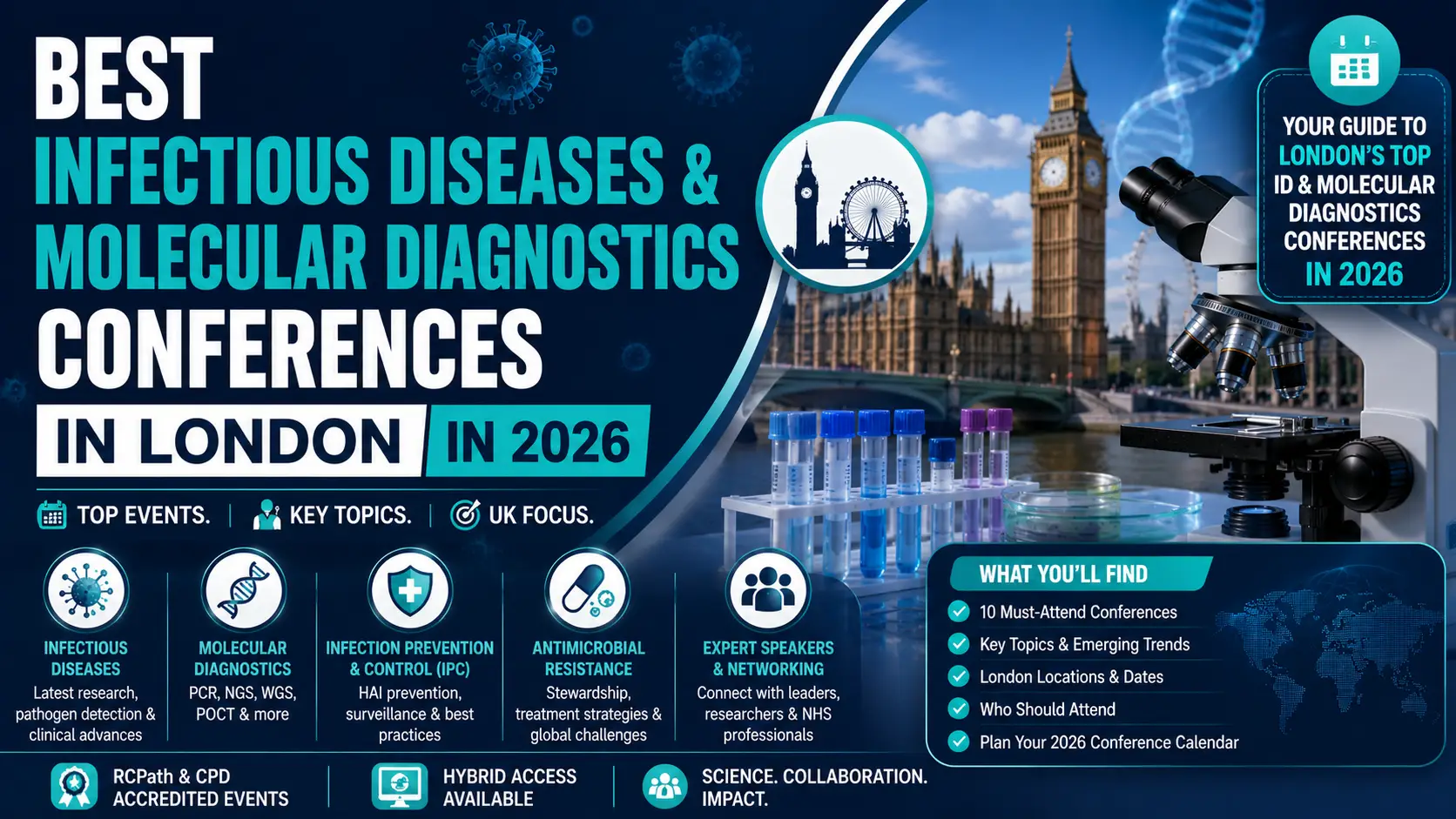
Best Infectious Diseases & Molecular Diagnostics Conferences In London In 2026
London sits at the centre of the UK’s infectious diseases and molecular diagnostics research ecosystem. The London School of Hygiene and Tropical Medicine, UKHSA, Imperial College London, and major NHS trusts including UCLH, King’s College Hospital, and Chelsea and Westminster collectively make the city one of the most active hubs for infectious disease research and clinical innovation in Europe.
The result is a dense London conference calendar in 2026. Events range from single-day NHS practitioner meetings to two-day international congresses, covering everything from point-of-care molecular testing to antimicrobial resistance drug development. This guide maps the key London events, who each one serves, and what to expect from the programming.
- London hosts a cluster of infectious diseases and molecular diagnostics events between April and June 2026, allowing professionals to attend multiple conferences without repeated travel.
- Society-run events (BSAC, HIS, BSMT) offer RCPath and CPD accreditation, making them practical professional development choices for NHS scientists and clinicians alongside scientific content.
- Antimicrobial resistance and molecular diagnostics are converging across London’s 2026 conference programming. NGS, whole genome sequencing, and AI-assisted diagnostic interpretation feature across multiple events.
- Several London conferences offer hybrid attendance, making them accessible to professionals outside the city without losing access to the speaker lineup and sessions.
The 10 best infectious diseases & molecular diagnostics conferences in London at a glance
Below is an overview of the top 10 infectious diseases and molecular diagnostics conferences in London in 2026:
| Conference | Dates | Location | Best For |
| FutureDX Summit 2026 | May 14–15, 2026 | Copthorne Tara Hotel London Kensington | Infectious disease clinicians, clinical microbiologists, laboratory and molecular diagnostics professionals |
| BSMT 41st annual microbiology conference | May 21, 2026 | RAF Museum, Hendon, London | NHS biomedical scientists, clinical microbiologists |
| HISCON 2026 | Jun 23–24, 2026 | Royal College of Physicians, London | IPC professionals, HAI researchers, clinical scientists |
| 18th Euro-Global infectious diseases conference | Apr 16–17, 2026 | London | ID researchers, clinicians, public health professionals |
| 13th International Congress on infectious diseases | Apr 16–17, 2026 | London | ID researchers, pharma, early-career scientists |
| IDAMR 2026 | Jun 25–26, 2026 | London | ID physicians, AMR researchers, health economists |
| GIOH 2026 | Sep 21–23, 2026 | London (hybrid) | ID researchers, genomics, One Health, diagnostics |
| BSAC Infection 2026 | Dec 9–10, 2026 | London (hybrid) | Clinical microbiologists, infectious disease physicians |
| BSAC ARM workshop 2026 | Nov 25–26, 2026 | Birmingham* | AMR mechanisms, resistance detection, laboratory science |
| Building Safer Hospitals 2026 | Nov 9, 2026 | London | IPC, hospital design, built environment infection prevention |
*Please note: one regional exception included for completeness given its direct relevance to the London BSAC audience
- London location: Priority given to events held within Greater London, with one regional exception noted
- Relevance to molecular diagnostics and infectious diseases: Does the event cover PCR, NGS, whole genome sequencing, point-of-care testing, or pathogen identification?
- Organizational credibility: Events run by established professional societies (BSAC, HIS, BSMT) are weighted higher than commercially organized events
- Audience specificity: Does the event serve a clearly defined professional group rather than a generic catchall audience?
- CPD or RCPath accreditation: Noted where confirmed, as this is a practical decision factor for NHS professionals
P.S. No conference paid for placement. We created this list based on market research and events’ relevance in the London region.
Best infectious diseases & molecular diagnostics conferences in London (2026)
Let’s review each conference in detail.
1. FutureDX Summit 2026
October 27–28, 2026 | Copthorne Tara Hotel London Kensington, London
FutureDX Summit 2026 is a two-day London conference dedicated to infectious diseases and molecular diagnostics. Its programme connects diagnostic innovation with clinical and public health applications, covering molecular testing, AI-enabled diagnostics, antimicrobial resistance, point-of-care testing, emerging pathogens, and diagnostic approaches for conditions such as sepsis and drug-resistant tuberculosis.
The summit is designed to bring together hospitals and clinical laboratories, diagnostic companies, biotech and pharma organisations, academic researchers, and public health authorities. Its focus on molecular diagnostics makes it particularly relevant to professionals involved in pathogen detection, rapid testing, genomic approaches, and diagnostic decision-making.
Best for: Infectious disease consultants, clinical microbiologists, NHS laboratory directors, clinical and biomedical scientists, POCT coordinators, public health scientists, diagnostic developers, and biotech and pharma professionals.
2. BSMT 41st annual microbiology conference
May 21, 2026 | Royal Air Force Museum, Hendon, London
The British Society for Microbial Technology (BSMT) runs this single-day conference for bench microbiologists. Sessions focus on the current state of molecular diagnostics, new clinical microbiology lab technologies, and the practical tension between culture-based methods and rapid molecular testing.
The 2026 programme includes a session on “Current state and the potential future for diagnostic microbiology” from Dr Sarah Pitt (University of Brighton), alongside talks on domestically acquired infections and AMR surveillance. The conference is registered with the RCPath; CPD certificates are available on request. Early bird registration is £75 (before April 20, 2026).
Best for: Senior biomedical scientists, clinical scientists, medical microbiologists, and NHS laboratory professionals running diagnostic microbiology services day-to-day.
3. HISCON 2026 – HIS annual conference
June 23–24, 2026 | Royal College of Physicians, London
HISCON is the annual conference of the Healthcare Infection Society (HIS), a registered UK charity and one of the most credentialed bodies in hospital infection research. Confirmed speakers include Jincy Jerry (Director of IPC, NHS Ayrshire and Arran), Prof Michael Klompas (Harvard Medical School), Dr Gemma Winzor (Editor-in-Chief, Infection Prevention in Practice), and Dr Martyn Wilkinson (Editor-in-Chief, Journal of Hospital Infection).
The 2026 programme features oral presentations, a larger poster exhibition, and an expanded exhibition of the latest innovations in infection prevention products and technologies. CPD credits are approved by the RCPath.
Best for: IPC professionals, clinical microbiologists, infectious disease specialists, HAI researchers, infection nurses, NHS clinical scientists, and anyone working in healthcare-associated infection across acute and community settings.
4. 18th Euro-Global infectious diseases conference
April 16–17, 2026 | London
This two-day conference covers the full spectrum of infectious diseases, with dedicated sessions on molecular tools and diagnostics. Sessions address PCR and next-generation sequencing for pathogen detection, AI-assisted diagnostic interpretation, and point-of-care diagnostics in resource-limited settings. Programming includes oral and poster presentations, panel discussions, and industry-led workshops. Accepted abstracts are published in Conference Series journals.
Best for: ID researchers, clinicians, microbiologists, epidemiologists, public health professionals, and pharmaceutical industry representatives.
5. 13th International Congress on infectious diseases
April 16–17, 2026 | London
This congress runs under the theme “Infectious Diseases in a Changing World: Challenges, Progress, and Future Directions.” Sessions cover antimicrobial resistance, emerging and re-emerging pathogens, molecular diagnostics, vaccines, and public health strategy. The event is positioned at the intersection of academic research, clinical innovation, and industry collaboration.
With projected attendance of 300–500 delegates from 40+ countries, this event offers networking across pharma, biotech, diagnostics companies, and academic institutions.
Best for: Microbiologists, virologists, infectious disease specialists, epidemiologists, public health authorities, and pharmaceutical and diagnostics industry professionals.
6. IDAMR 2026 – 4th World Congress on infectious diseases and antimicrobial resistance
June 25–26, 2026 | London
IDAMR 2026 focuses on the economic and clinical urgency of antimicrobial resistance. Sessions cover next-generation antibiotics, diagnostics innovation, AI-driven surveillance, and antimicrobial stewardship program design. The infectious disease diagnostics market is projected to exceed $40 billion by 2028, and the congress positions itself around evidence-based solutions that bridge research, clinical practice, and commercial strategy.
Best for: ID physicians, pharma and biotech researchers, health economists, microbiologists, regulatory professionals, and policymakers.
7. GIOH 2026 – Global infectious diseases & one health conference
September 21–23, 2026 | London (hybrid)
GIOH 2026 runs under the theme “From Breakthroughs to Preparedness: The Next Era of Infectious Diseases.” The CPD-accredited conference covers molecular biology, genomics, digital biosurveillance, AI-driven disease prediction, and outbreak preparedness. Sessions address human, animal, and environmental health in an integrated framework. The hybrid format enables international participation alongside the London in-person programme.
Best for: ID researchers, clinical scientists, veterinarians, public health officials, data scientists, and policymakers working across human, animal, and environmental health.
8. BSAC Infection 2026
December 9–10, 2026 | London (hybrid)
BSAC’s winter conference brings together the lab and the clinic. Previous editions have featured sessions on molecular diagnostics for virology, AMR surveillance, clinical-pathological case studies, and next-generation sequencing applied to diagnostic microbiology. The conference has historically attracted speakers from UKHSA, Imperial College Healthcare NHS Trust, UCLH, and NHS Greater Glasgow. RCPath CPD accreditation confirmed for previous editions; 2026 details to follow.
Best for: Consultant microbiologists, infectious disease clinicians, infection pharmacists, and trainees from across the UK and internationally.
9. BSAC ARM workshop 2026
November 25–26, 2026 | Birmingham (regional event serving the broader BSAC London audience)
BSAC’s Antimicrobial Resistance Mechanisms (ARM) Workshop is a focused two-day in-person event for scientists who want deep technical discussion on resistance mechanisms, molecular surveillance approaches, and novel resistance detection methods. Early bird registration closes June 19, 2026.
Best for: Microbiologists, laboratory scientists, AMR researchers, and pharmaceutical scientists working on resistance detection and characterization.
10. Building Safer Hospitals 2026
November 9, 2026 | London
Building Safer Hospitals is a one-day conference run by the Healthcare Infection Society’s Built Environment Infection Prevention Initiative (BEIPI). It brings together built environment professionals and healthcare teams to address how hospital design, ventilation, water systems, and environmental controls reduce infection risk. It is the only London conference dedicated specifically to the physical infrastructure of infection prevention.
Best for: IPC professionals, NHS estates leads, hospital designers and architects, clinical scientists, and infection control specialists working at the intersection of healthcare design and infectious disease prevention.
“Molecular diagnostics is everywhere, but FutureDX is more focused. BSMT, GIOH, BSAC, and other London events include molecular diagnostics within broader programmes; FutureDX Summit is specifically built around infectious diseases and molecular diagnostics.”
What the London 2026 calendar tells us
- April to June is the busiest window. Several London conferences land between April 16 and June 26, allowing professionals based in or near London to cover a significant portion of the year’s infectious diseases and diagnostics content without repeated travel.
- Molecular diagnostics is everywhere, but FutureDX is more focused. BSMT, GIOH, BSAC and other London events include molecular diagnostics within broader programmes. FutureDX Summit is specifically built around infectious diseases and molecular diagnostics, with dedicated coverage of molecular testing, point-of-care solutions, AMR detection, AI, and emerging diagnostic technologies.
- AMR science and clinical practice are converging. BSAC’s two London conferences, IDAMR, HISCON, and FutureDX all address different aspects of infection management, diagnostics, and antimicrobial resistance.
- The built environment is entering the IPC conversation. Building Safer Hospitals 2026 represents a relatively new strand in London’s infection prevention calendar, connecting NHS estates teams with IPC professionals on hospital design and environmental controls.
Planning your London 2026 conference calendar
London’s infectious diseases and molecular diagnostics events in 2026 cover bench scientists, IPC nurses, clinical microbiologists, AMR researchers, diagnostics professionals, and hospital estates teams across a calendar that spans April through December.
For laboratory and molecular diagnostics professionals, BSMT (May 21), BSAC Infection 2026 (December), and FutureDX Summit (October 27–28) offer different approaches to diagnostic microbiology. FutureDX is particularly focused on infectious disease diagnostics, with dedicated coverage of molecular testing, rapid and point-of-care diagnostics, AMR detection, and AI-enabled diagnostic workflows.
For IPC clinicians, HISCON 2026 (June) and Building Safer Hospitals (November) provide distinct perspectives on clinical practice and the built environment. For AMR researchers and ID physicians, BSAC Spring, IDAMR, and the BSAC ARM Workshop form a broader programme across the year.
Check each conference’s official website for registration deadlines, abstract submission windows, and CPD accreditation details.
1. Which London conferences in 2026 specifically cover molecular diagnostics techniques including PCR, NGS, and whole genome sequencing?
BSMT (May 21, Hendon), BSAC Infection 2026 (Dec 9–10), and GIOH 2026 (Sep 21–23) all include dedicated sessions on molecular diagnostics technology, NGS applications, and AI-assisted diagnostic interpretation.
2. Which London infectious diseases conferences in 2026 carry RCPath CPD accreditation?
BSMT (May 21) is RCPath registered with CPD certificates available on request. HISCON 2026 (Jun 23–24, RCP London) is RCPath CPD-approved. BSAC Infection 2026 has historically carried RCPath CPD credits; confirm 2026 details directly with BSAC.
3. Are there London events specifically focused on antimicrobial resistance science and drug development in 2026?
IDAMR 2026 (Jun 25–26) and the BSAC Spring Conference (May 14–15) both focus directly on antimicrobial resistance science, next-generation antibiotics, and stewardship strategy. The BSAC ARM Workshop (Nov 25–26, Birmingham) covers resistance mechanisms at the deepest technical level.
4. Which London conferences are suitable for early-career researchers or professionals attending on limited budgets?
BSMT (single-day, from £75 early bird; £35 for students) is the most cost-accessible London option. The 18th Euro-Global ID Conference and 13th International Congress (both April 16–17) offer poster presentation opportunities that suit early-career researchers looking to present work alongside attending sessions.
5. How does FutureDX Summit differ from broader London infectious diseases conferences?
FutureDX Summit is specifically focused on the intersection of infectious diseases and molecular diagnostics, rather than covering the full infectious diseases landscape. Its programme centres on molecular testing, rapid and point-of-care diagnostics, AMR detection, AI and predictive analytics, and emerging diagnostic technologies. This makes it particularly relevant to laboratory, diagnostics, clinical microbiology, and infectious disease professionals looking for a focused diagnostics programme.