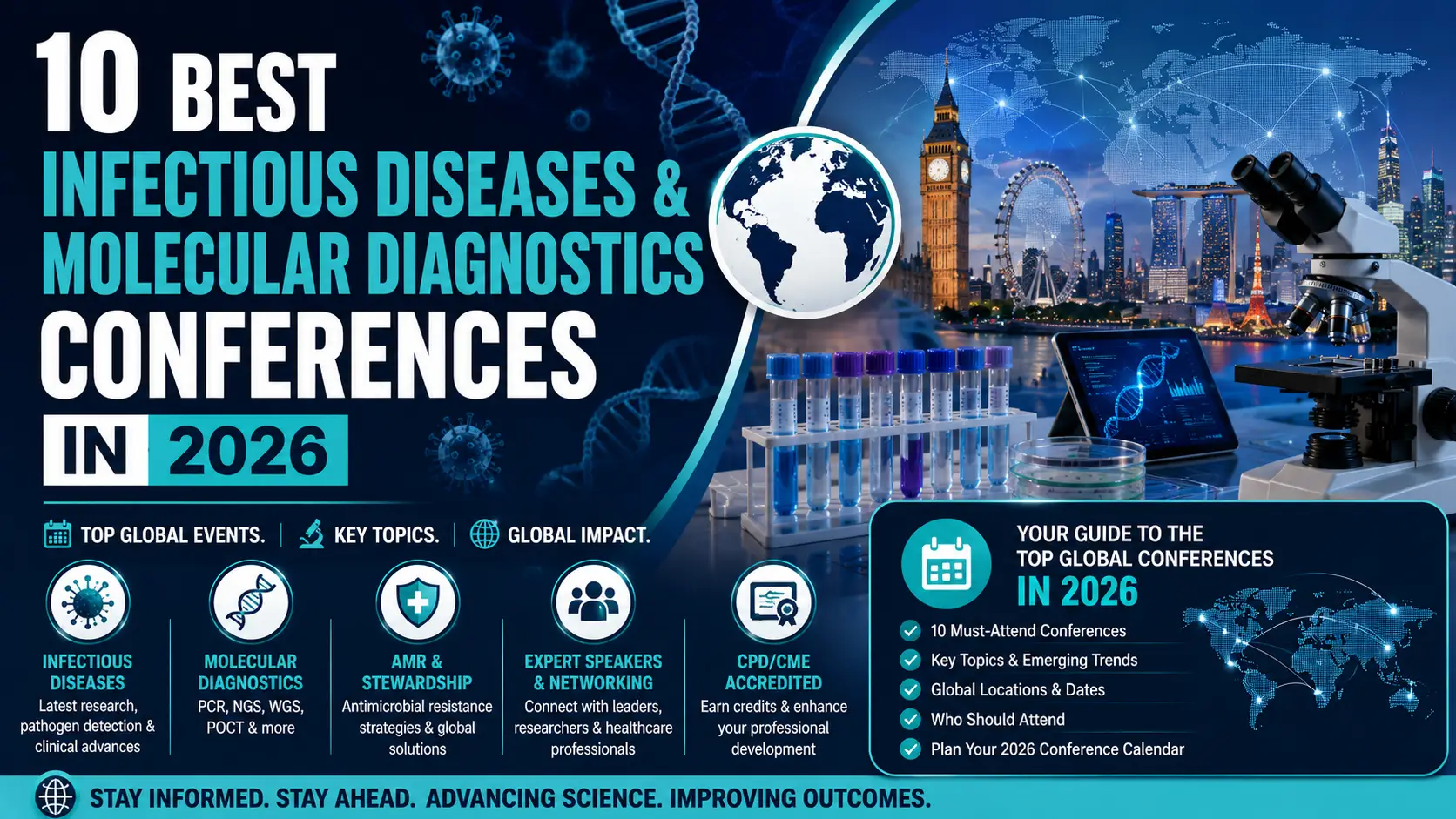
10 Best Infectious Diseases & Molecular Diagnostics Conferences In 2026
The global infectious diseases and molecular diagnostics conference calendar for 2026 reflects the significant shift in the field since the pandemic. Antimicrobial resistance is on course to cause 10 million deaths per year by 2050. The infectious disease diagnostics market is projected to exceed $40 billion by 2028. Whole genome sequencing, AI-assisted diagnostic interpretation, and point-of-care molecular testing have moved from research tools to clinical practice staples.
Conferences have followed. Events across the US, Europe, Asia-Pacific, and the UK now routinely combine molecular diagnostics science with AMR stewardship, clinical microbiology, and public health strategy. This guide maps the key global events, who each one serves, and what to expect from the programming.
- ESCMID Global 2026 (Munich, Apr 17–21) is the world’s largest clinical microbiology and infectious diseases conference, drawing 16,000+ attendees and offering up to 33 CME points.
- Molecular diagnostics, including NGS, PCR, CRISPR-based tools, and AI-assisted platforms, appear as a dedicated track across nearly every major 2026 infectious diseases conference globally.
- Geographic spread matters for who you meet. US events concentrate pharma and regulatory contacts; Asia-Pacific events connect you with regional AMR surveillance networks; European events provide access to ECDC and EU regulatory stakeholders.
- Hybrid formats are now standard at most large conferences, with on-demand CME access available for up to six months after the event at several major events.
10 Best Infectious Diseases & Molecular Diagnostics Conferences At A Glance
Here are the 10 best infectious diseases and molecular diagnostics conferences at a glance:
| Conference | Dates | Location | Best For |
| FutureDX Summit 2026 | Oct 27–28, 2026 | Munich, Germany | Infectious disease clinicians, clinical microbiologists, diagnostics and laboratory professionals |
| IDWeek 2026 | Oct 21–24, 2026 | Washington D.C., USA (hybrid) | ID clinicians, hospital epidemiologists, pharmacists, trainees |
| ISAAR 2026 | Jun 12–14, 2026 | Hong Kong | Asia-Pacific AMR and infectious disease researchers |
| Infection 2026 | Jun 25–27, 2026 | Barcelona, Spain (hybrid) | ID specialists, epidemiologists, public health researchers |
| IDAMR 2026 | Jun 25–26, 2026 | London, UK | ID physicians, AMR researchers, health economists |
| GIOH 2026 | Sep 21–23, 2026 | London, UK (hybrid) | ID researchers, genomics, One Health, molecular diagnostics |
| WCID 2026 | Oct 5–7, 2026 | Tokyo, Japan (hybrid) | ID researchers, public health, One Health, surveillance |
| IMARI 2026 | Jan 28–30, 2026 | Las Vegas, USA | AMR drug discovery, clinical microbiologists, policymakers |
| BSAC Spring Conference 2026 | May 14–15, 2026 | London, UK (hybrid) | Infection management, AMR diagnostics, stewardship |
| BSMT 41st Annual Microbiology Conference | May 21, 2026 | London, UK | NHS biomedical scientists, clinical microbiologists |
- Relevance to molecular diagnostics and infectious diseases: Does the event cover PCR, NGS, whole genome sequencing, point-of-care testing, or pathogen identification?
- Scientific standing: Does the event feature peer-reviewed content or speakers from credentialed institutions?
- Geographic diversity: Does the list serve professionals across North America, Europe, Asia-Pacific, and the UK?
- Audience specificity: Does the event serve a clearly defined professional group rather than a generic catchall audience?
- CME or CPD accreditation: Noted where confirmed, as this is a practical decision factor for clinicians and NHS professionals choosing between events.
P.S. No conference paid for placement. We created this list based on market research and events’ relevance in the London region.
Best Infectious Diseases & Molecular Diagnostics Conferences 2026
Let’s review each conference in detail.
1. FutureDX Summit 2026
Dates: October 27–28, 2026
Location: Copthorne Tara Hotel London Kensington, London, UK
Best for: Infectious disease clinicians, clinical microbiologists, laboratory leaders, molecular diagnostics professionals, biomedical scientists, public health professionals, and diagnostics companies
What this conference is best known for: A focused international summit bringing together infectious disease science and molecular diagnostics, with an emphasis on translating diagnostic innovation into clinical and public health applications. FutureDX Summit covers next-generation molecular testing, antimicrobial resistance, AI and predictive analytics, point-of-care diagnostics, emerging pathogens, and the evolving role of diagnostics in infectious disease management.
The two-day programme brings together diagnostic professionals, clinicians, laboratory leaders, technologists, biotech innovators, and public health stakeholders. Topics include multiplex PCR, genomic sequencing, lateral flow technologies, AI-enabled diagnostics, AMR detection and surveillance, rapid testing, and diagnostics for sepsis and drug-resistant infections.
Who attends: Infectious disease physicians, clinical microbiologists, laboratory directors, biomedical and clinical scientists, POCT professionals, public health scientists, biotech and pharma leaders, and molecular diagnostics companies.
2. IDWeek 2026
Dates: October 21–24, 2026
Location: Walter E. Washington Convention Center, Washington D.C., USA (hybrid)
Best for: Infectious disease physicians, hospital epidemiologists, ID pharmacists, microbiologists, and trainees
What this conference is best known for: The largest annual infectious diseases gathering in the US, co-organized by IDSA, SHEA, HIVMA, PIDS, and SIDP.
IDWeek 2026 marks the 15th anniversary of the joint meeting. Sessions span antimicrobial resistance, healthcare-associated infections, HIV, molecular diagnostics, emerging pathogens, and infection prevention and control. Up to 12 AMA PRA Category 1 CME credits are available. Pre-meeting workshops include a board review session, an antimicrobial stewardship workshop, and a dedicated program for ID educators.
General registration opens June 2, 2026. The IDBugCrawl programme offers medical students and residents a VIP track free of charge.
Who attends: Clinicians, researchers, public health professionals, ID pharmacists, trainees, and policymakers from across the US and internationally.
3. ISAAR 2026
Dates: June 12–14, 2026
Location: Hong Kong Convention and Exhibition Centre, Hong Kong
Best for: Infectious disease clinicians, microbiologists, and public health researchers in or connected to the Asia-Pacific region
What this conference is best known for: The Asia-Pacific’s most authoritative biennial forum on antimicrobial resistance, organized under the theme “Fighting the ongoing pandemic of antimicrobial resistance.”
ISAAR is organized by the Asia Pacific Foundation for Infectious Diseases (APFID), co-organized with the Hong Kong Society for Infectious Diseases (HKSID) and the Hong Kong Society for Microbiology and Infection (HKSMI). Co-chairs from the Mayo Clinic (USA) and Samsung Medical Centre (Korea) guide the scientific programme alongside regional leaders. APFID also runs the Asian Network for Surveillance of Resistant Pathogens (ANSORP) and the Asian Bacterial Bank, making this conference directly connected to the region’s leading AMR surveillance infrastructure.
Who attends: Microbiologists, infectious disease clinicians, pharma scientists, public health researchers, and policymakers across the Asia-Pacific region.
4. Infection 2026 — 10th World Congress on Infectious Diseases
Dates: June 25–27, 2026
Location: Barcelona, Spain (hybrid)
Best for: Infectious disease specialists, epidemiologists, immunologists, and public health researchers seeking broad international coverage
What this conference is best known for: A broad-spectrum infectious diseases congress covering bacterial, viral, fungal, and parasitic infections under the theme “New Frontiers in Infectious Diseases: Diagnosis, Treatment, and Control.”
Sessions address emerging pathogens, infection control, molecular diagnostic advances, and therapeutic strategies. The three-day programme includes keynote sessions, oral and poster presentations, and interactive workshops. The hybrid format allows virtual participation for international attendees who cannot travel to Barcelona.
Who attends: ID specialists, epidemiologists, immunologists, public health researchers, and clinicians across all career stages.
5. IDAMR 2026 — 4th World Congress on Infectious Diseases and Antimicrobial Resistance
Dates: June 25–26, 2026
Location: London, UK
Best for: ID physicians, AMR researchers, health economists, pharma and biotech teams, and policymakers
What this conference is best known for: Positioning AMR as both a scientific and economic emergency, with the infectious disease diagnostics market projected to exceed $40 billion by 2028 as a framing for the agenda.
IDAMR 2026 covers next-generation antibiotics, molecular diagnostics innovation, AI-driven surveillance, precision antimicrobial therapies, and stewardship program design. Sessions bring together clinicians, researchers, pharmaceutical innovators, regulators, and policymakers working on evidence-based solutions to AMR.
Who attends: ID physicians, pharma and biotech researchers, health economists, microbiologists, regulatory professionals, and policymakers.
6. GIOH 2026 — Global Infectious Diseases & One Health Conference
Dates: September 21–23, 2026
Location: London, UK (hybrid)
Best for: ID researchers, genomics scientists, public health professionals, and clinicians working within a One Health framework
What this conference is best known for: Integrating molecular biology, genomics, and AI-driven surveillance within a One Health framework under the theme “From Breakthroughs to Preparedness: The Next Era of Infectious Diseases.”
GIOH 2026 is CPD-accredited and covers digital biosurveillance, AI-driven disease prediction, outbreak preparedness, mobile diagnostic devices, and cross-border coordination. Sessions address human, animal, and environmental health as interconnected systems. The hybrid format enables international participation alongside the London in-person programme.
Who attends: ID researchers, clinical scientists, veterinarians, public health officials, data scientists, and policymakers working across human, animal, and environmental health.
7. WCID 2026 — 10th World Congress on Infectious Diseases & One Health
Dates: October 5–7, 2026
Location: Tokyo, Japan (hybrid)
Best for: ID researchers, epidemiologists, public health leaders, and clinicians with an interest in global surveillance and One Health
What this conference is best known for: A truly international platform convening researchers, clinicians, public health experts, and policymakers under the theme “From Pathogens to Prevention: Science, Surveillance, and Solutions.”
WCID 2026 features keynote addresses from internationally recognized experts, oral and poster presentations, panel discussions, and hands-on workshops. Tokyo’s location makes it a natural hub for Asia-Pacific networking, with strong representation from Japanese academic institutions, regional health ministries, and international research organizations.
Who attends: ID specialists, researchers, epidemiologists, public health professionals, industry representatives, and policymakers from across Asia-Pacific and internationally.
8. IMARI 2026
Dates: January 28–30, 2026 (completed; watch imari.org for next edition)
Location: Las Vegas, Nevada, USA
Best for: AMR researchers, antimicrobial drug developers, clinical microbiologists, and health policy professionals
What this conference is best known for: The inaugural dedicated forum for antimicrobial resistance drug discovery and translational science, launched jointly by ASM and IDSA.
IMARI is a new conference focused narrowly on antimicrobial resistance drug discovery, development, and the translational steps between bench and bedside. Sessions cover resistance mechanisms, AI-powered molecule design, public-private partnerships, and regulatory pathways for new antimicrobials. Its inaugural 2026 edition positions it as the most specialized AMR event in the US calendar.
Who attends: Bench scientists, clinical microbiologists, pharma R&D teams, government agencies, and policymakers working on the AMR drug pipeline.
9. BSAC Spring Conference 2026
Dates: May 14–15, 2026
Location: QEII Centre, London, UK (hybrid)
Best for: Infectious disease clinicians, clinical microbiologists, infection pharmacists, researchers, and public health professionals
What this conference is best known for: Bridging bench science and clinical practice around antimicrobial stewardship and AMR diagnostics, with a theme of “Advancing Infection Management: From Global Challenges to Clinical Innovation.”
The British Society for Antimicrobial Chemotherapy (BSAC) Spring Conference covers antimicrobial diagnostics, urinary tract sepsis, HAP/VAP, and carbapenem-sparing treatment strategies. Sessions deliver evidence-based learning applicable directly to antimicrobial stewardship decisions. The hybrid format makes it accessible globally.
Who attends: Infectious disease physicians, clinical microbiologists, infection pharmacists, GP researchers, and public health professionals spanning clinicians, scientists, and social scientists working in infection.
10. BSMT 41st Annual Microbiology Conference
Dates: May 21, 2026
Location: Royal Air Force Museum, Hendon, London, UK
Best for: NHS biomedical scientists, clinical microbiologists, and healthcare scientists working in diagnostic microbiology
What this conference is best known for: The most practically oriented annual UK event for bench microbiologists, with a focus on the current state and future of molecular diagnostics in clinical microbiology labs.
The BSMT runs this single-day conference specifically for diagnostic laboratory professionals. The 2026 programme includes “Current state and the potential future for diagnostic microbiology” from Dr Sarah Pitt (University of Brighton), alongside sessions on domestically acquired infections and AMR surveillance. The conference is RCPath-registered; CPD certificates are available on request. Early bird registration from £75.
Who attends: Senior biomedical scientists, clinical scientists, medical microbiologists, and NHS laboratory professionals running diagnostic microbiology services day-to-day.
“Molecular diagnostics and infectious diseases are increasingly interconnected across the global 2026 conference calendar, with FutureDX Summit taking a focused approach to bringing diagnostic science together with clinical and public health applications.”
What The 2026 Global Calendar Tells Us
- Molecular diagnostics is now a standard conference track. NGS, PCR, CRISPR-based tools, and AI-assisted interpretation appear across major events on this list, from ESCMID Global to WCID Tokyo. FutureDX Summit 2026 takes a more focused approach, bringing infectious disease and molecular diagnostics together with dedicated coverage of molecular testing, rapid diagnostics, AI, and emerging diagnostic technologies.
- AMR science and drug development are converging. IMARI, ISAAR, IDAMR, BSAC, and FutureDX Summit all address different aspects of antimicrobial resistance, from drug discovery and regional surveillance to diagnostics, stewardship, and clinical application. Together, they show how AMR research is increasingly connecting laboratory science with diagnosis and treatment decisions.
- One Health is no longer a niche framing. GIOH 2026 and WCID 2026 both structure their programmes around the human-animal-environment interface. This reflects a broader shift in how infectious disease science is being organized globally.
- On-demand access is extending conference value. ESCMID Global sessions remain available until October 31, 2026. IDWeek on-demand content runs through March 2026. At the same time, events such as FutureDX Summit offer an in-person forum for professionals looking to engage directly with researchers, clinicians, diagnostics companies, and other stakeholders working in infectious disease diagnostics.
Planning Your 2026 Global Conference Calendar
The events above cover infectious diseases and molecular diagnostics professionals across every career stage, geography, and professional role, from diagnostic microbiologists and laboratory scientists to AMR researchers, clinicians, and public health professionals.
A practical approach: the first half of 2026 is front-loaded with major specialist events, including IMARI, ESCMID Global, ISAAR, and Infection 2026. The second half adds GIOH, WCID Tokyo, IDWeek, and FutureDX Summit in London. FutureDX is particularly relevant for professionals looking for a focused programme centred on infectious disease diagnostics and molecular testing rather than a broad clinical infectious diseases congress.
Check each conference’s official website for registration deadlines, CME or CPD accreditation details, and abstract submission windows.
1. Which 2026 global conference is specifically focused on infectious disease and molecular diagnostics?
FutureDX Summit 2026 (London, October 27–28) is specifically focused on the intersection of infectious diseases and molecular diagnostics. The programme covers molecular testing, AI and predictive analytics, AMR detection, point-of-care diagnostics, emerging pathogens, and clinical applications of diagnostic innovation.
2. Which 2026 conferences focus specifically on molecular diagnostics techniques like NGS, PCR, and AI-assisted interpretation?
ESCMID Global, GIOH 2026, Infection 2026, and BSMT all include dedicated molecular diagnostics tracks covering NGS applications, PCR platforms, CRISPR-based tools, and AI-assisted diagnostic interpretation.
3. Which conferences on this list are the best fit for Asia-Pacific infectious disease and AMR researchers?
ISAAR 2026 (Hong Kong, Jun 12–14) and WCID 2026 (Tokyo, Oct 5–7) are the primary Asia-Pacific events. ISAAR is the more AMR-specific of the two; WCID covers the broader infectious diseases and One Health landscape.
4. Are there 2026 conferences that combine AMR drug development with regulatory and policy perspectives?
IMARI 2026 (Las Vegas, Jan 28–30) and IDAMR 2026 (London, Jun 25–26) both combine AMR science with drug development, regulatory pathways, and policy discussions. BSAC Spring Conference (London, May 14–15) adds a clinical stewardship lens to the same intersection.
5. How do society-run infectious diseases conferences differ from commercially organized events in terms of programming quality?
Society-run events (ESCMID, IDSA/IDWeek, BSAC, BSMT, APFID/ISAAR) typically feature peer-reviewed content, independent scientific programme committees, and programming tied directly to membership professional development needs. Commercially organized events often offer broader access and more flexible abstract submission criteria, which can suit early-career researchers and industry professionals seeking presentation opportunities.